• Skip to primary navigation
  • Skip to main content
  • Skip to primary sidebar
  • Zoom
  • Courts
  • Docket search (Odyssey)
  • Weekly calendars
  • WA court forms
  • Local feature articles

Clallam County Bar

Clallam County lawyers & legal news

Angeles Mediation

Avoid Court. Reduce costs. Quick results.

The alternative to going to court

Angeles Mediation

  • Home
  • Find a Lawyer
    • All Clallam Co. Lawyers
    • Accident/Personal Injury
    • Business, Corporation, Partnership
    • Criminal
    • Divorce & Family
    • Elder Law
    • Mediation
    • Other
    • Real Estate
    • Wills, Estate Planning, Probate
  • Bar News
    • Family Law
    • CLE
    • Pro Bono Events
    • DV Blog
  • Pro Bono
    • Pro Bono Events
    • Courthouse Facilitator
    • Domestic Violence Service Providers
    • Project Homeless Connect
    • Low Bono
  • Parenting
  • Services and Experts
  • Contact

Domestic violence news and research

Courthouse Facilitator position vacant until March 1 2026

January 27, 2026

The Clallam County Courthouse Facilitator position is currently vacant. A new Facilitator will begin offering help with filling out court forms on March 1, 2026.

Temporary help

In the meantime, Port Angeles Pro Bono is offering limited Facilitator-type services. Click here for information and to apply for services
Filed Under: Bar News, Domestic Violence, Family Law

Hope Card: easy carry protection order information

January 11, 2025

Washington Hope Card Program

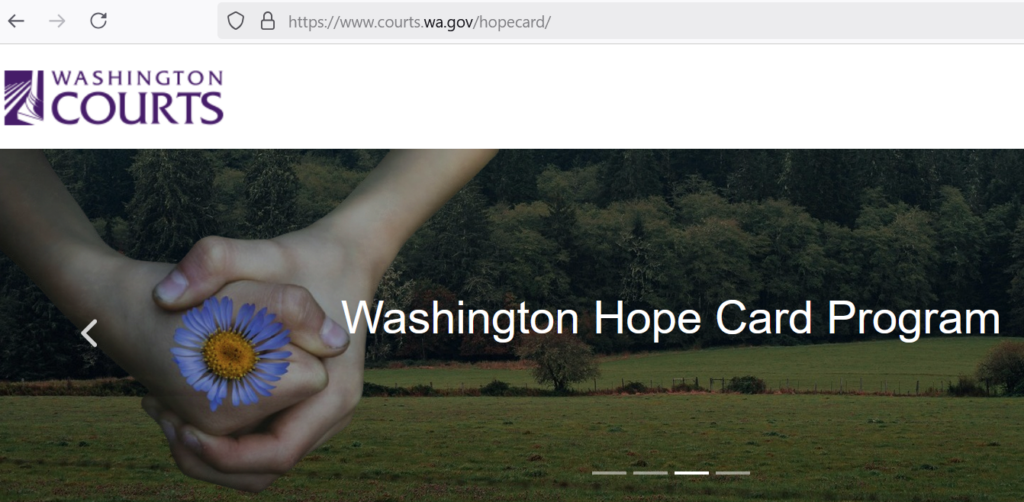
The new Washington Hope Card is an easy to carry version of a domestic violence protection order. Anyone who has obtained a protection order may request the credit card sized Hope Card from the Washington Court administrative office in Olympia. More information and an online application form is available at the Washington Court’s web page for the Hope Card, https://www.courts.wa.gov/hopecard/.

The Hope Card makes it easier to carry proof of an order you have obtained from a county court, such as the Clallam County Superior or District Courts It eliminates the need to carry a copy of the full protection order.

There is no charge for the Hope Card. It is valid so long as the protection is valid. Most protection orders last for one year, but they can be shorter or longer, The length of an order is usually stated on the first page of the full order.

Please note, applying for a Hope Card is not allowed until after a protection order is obtained from a judge. Hope Cards are not available for Temporary Protection Orders, and applying for a Hope Card will not start the process of getting a protection order. To get a protection order you need to file a Petition for a Protection order, or file a petition and motion for an order in an existing law suit such as a divorce, parenting plan, or child support case. Forms are available at the Washington Courts web page and any domestic violence agency can help you fill out the forms and offer help for free. Any domestic violence agency can serve in Clallam County. Local agencies include Mariposa House, Healthy Families, Lower Elwha Klallam Domestic Violence Program, and Dove House.

Hope Cards are available for:

  • Domestic Violence Protection Order (DVPO)
  • Sexual Assault Protection Order (SAPO)
  • Stalking Protection Order (SPO)
  • Vulnerable Adult Protection Order (VAPO)
  • Anti-Harassment Protection Order (AHPO)

In Washington, “domestic violence” includes physical and emotional violence or aggression and coercive control.

For more information about Hope Cards, go to https://www.courts.wa.gov/hopecard/.

Filed Under: Bar News, Domestic Violence, Family Law, Low Bono, Pro Bono Events

Low Bono mediation 2023: Family Law Project

February 19, 2023

Port Angeles Pro Bono and Angeles Mediation are offering low bono family law mediations in 2023, for residents in Clallam and Jefferson counties. Low bono means low cost services by a lawyer working as a mediator. For more information see the Port Angeles Pro Bono page.

Filed Under: Domestic Violence, Family Law, Low Bono, Mediation, Parenting, Pro Bono Events

Judges domestic violence manual available online

August 27, 2022

The Washington Court’s 2016 official Domestic Violence Manual for Judges is available online at https://www.courts.wa.gov/index.cfm?fa=home.contentDisplay&location=manuals/domViol/index.

It is available as a searchable series of web pages and as one PDF file for downloading.

The DV manual is a bit disorganized since it is written by a series of authors, but overall it is a fairly comprehensive review of domestic violence. It has not been updated to include information about Washington’s new domestic violence law in RCW 7.105, which was adopted in July 2022.

It does talk about coercive control, but not as defined in RCW 7.105. Washington’s new law allows for people to obtain a protection order based on coercive control which does not involve physical violence. However, the concept of coercive control has been around for many years and the 2016 Judge’s DV Manual references the concept.

Filed Under: Bar News, Domestic Violence, Family Law Tagged With: Domestic violence, judges

Clallam Resilience Project: Transforming substance abuse stigma

March 8, 2022

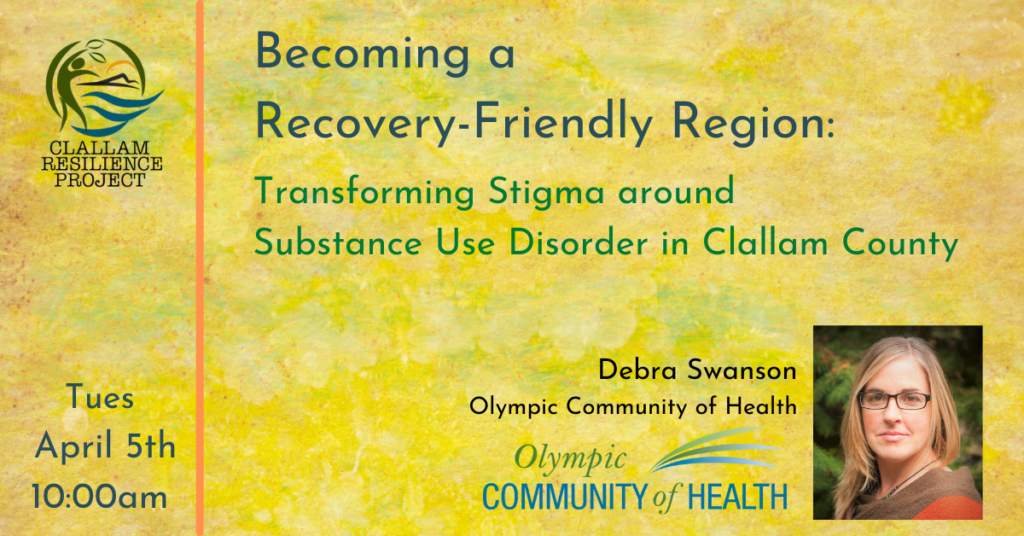
The Clallam Resilience Project’s monthly programming will cover managing the stigma of substance abuse. CRP is a United Way of Clallam County program.

Olympic Community of Health (OCH) recently conducted a research project exploring the presence of stigma of substance addiction across the Olympic region (Kitsap, Clallam, and Jefferson Counties). Our goal is to raise awareness of the presence of stigma on a local level, build understanding of how stigma impacts the community, and discuss a path forward in addressing stigma. Together, we can foster a region of healthy people, thriving communities. 

Join Zoom Meeting
Meeting ID: 899 2819 4489  Passcode: HOPE
Date: April 5, 2022, 10:00 a.m.

Our monthly Community Meetings each feature a local presenter speaking on topics connected to toxic stress, resiliency, and trauma-informed practices.  They are free, virtual, and open to the public, and happen every First Tuesday of the month from 10:00 – 11:30am.

Contact Kaelan Gilman for more information.
[email protected]
Learning & Outreach Coordinator
Clallam Resilience Project
United Way of Clallam County

Filed Under: Domestic Violence, Family Law, Mental health

The forgotten heroes: Family and friends who call DV helplines

November 11, 2021

People who experience domestic violence are often hesitant to disclose their stories and reach out for help. Family and friends who have concerns or questions or who may be unsure about what is going on “behind closed doors” should call a domestic violence helpline. There are several agencies on the North Olympic Peninsula, all listed below. You can also call the National Domestic Violence Hotline at 800-799-7233

Seeing someone suffer from potential or actual domestic violence can be confusing, involve feelings of helplessness, isolation, and uncertainty about whether or not something should be done. It’s free to call a DV help agency and that is what they are for so they appreciate your calls. They can offer you information about all the many forms of domestic violence, which is also known by the phrases intimidation, bullying, coercive control, power and control, intimate partner violence, emotional or psychological abuse.

ClallamCountyBar.com recommends family and friends call sooner rather than later. Controlling behaviors tend to escalate so the sooner they are tended to the sooner everyone, including the children, can be safe and free to live life without fear.

Coercive control and DV are very common in America. Sometimes both people are involved but usually one person is the main driver and it can be by man or woman or by any gender. Research studies consistently find that over 33% of people experience some form of coercive control, so it’s common in society.

Possessive and controlling behaviors, and physical DV, often develop slowly, over time in a relationship, but can escalate quickly. DV doesn’t always involve physical control, which is why terms such as coercive control sometimes offer a better descriptive term.

Domestic violence comes in many forms, and usually involves a pattern of coercive behaviors, used by one person in a relationship to gain or maintain control over the other. It’s very common for control behavior to be done in a way that is hidden from family and friends, or is at least harder to see. Behaviors may include:

  • Isolating a person from family, friends and other social situations.
  • Limitations on freedom.
  • Stubborn refusal to compromise
  • Unrelenting threats, intimidation, and other forms of coercion to make others do what they want.
  • Switching between very charming behaviors and angry/aggressive behaviors.
  • Persistent blaming of others, and consistently avoiding true responsibility for one’s own actions.
  • Insisting other people solve problems.
  • Focus on self-needs, especially as an excuse to engage in controlling behaviors (they tend to want to satisfy their needs first, and other people’s needs take a back seat or get addressed “later.”
  • Minimizing behaviors used to control.
  • Denying they did anything at all.
  • Their stories and explanations are often “fuzzy” and difficult to follow. Their stories often make loose connections between things which when looked at a little more closely don’t actually make a lot of sense.
  • Put downs.
  • Threating to leave, make false reports to CPS or the police.
  • Doing illegal things to their partner.
  • Demanding their partner dismiss charges if they are filed.
  • Economic and financial control.
  • Emotional abuse.
  • Spiritual abuse.
  • Sexual abuse.
  • Stalking.
  • Weapon use or threats of use.
  • Physical abuse, including grabbing, pushing, spitting, kicking, throwing things, breaking things, and hitting. Harming animals and pets is an indicator of extreme and dangerous control. Choking (strangulation) is an indicator of very extreme domestic violence and increases the likelihood of death by 750%.

If your loved ones disclose concerns, seem to be oddly disappearing from social circles, show (or hide) bruises, feel overwhelmed by their relationships, it won’t hurt to call an agency and speak with an advocate about what you might seeing and feeling. For many reasons, it is often very hard for people who are in a DV situation to ask for help, but they need it. You may be able to help them get the help they need.

For professionals

The behaviors list above is based on traditional DV theory, and also on attachment theory as described by the Dynamic Maturational Model of Attachment and Adaptation (DMM). The DMM describes the attachment system as involving people’s use of self-protective strategies to survive danger. These strategies are usually developed in childhood, and the more extreme forms of strategies are developed in response to parents who lack skills to provide a nurturing and safe home environment. In adulthood, the strategies to survive a difficult childhood are often used in romantic relationships but are in many ways dysfunctional. When they don’t work, the person often just increases the intensity of the type of behavior. This is why DV tends to escalate. A more detailed list of typical “victim” and “aggressor” self-protective strategies from a DMM perspective is available here.

This article is based in part on a research article by Alison Gregory and colleagues.

Gregory, Alison, Anna Kathryn Taylor, Katherine Pitt, Gene Feder, and Emma Williamson. “‘.?.?. The Forgotten Heroes’: A Qualitative Study Exploring How Friends and Family Members of DV Survivors Use Domestic Violence Helplines.” Journal of Interpersonal Violence 36, no. 21–22 (November 2021): NP11479–505. https://doi.org/10.1177/0886260519888199.

Filed Under: Domestic Violence, Family Law

Domestic Violence help – During COVID-19 pandemic

March 28, 2020

Quick escape to Google.com

Domestic violence increases in time of stress and Shelter In Place type orders. At the same time, it can be even harder for victims of domestic violence to access services or even safely call for help living in close quarters. All North Olympic domestic violence agencies are answering intake calls and providing services, although their in-person services may be limited to some degree by social distancing needs. The state government is aware of the issues and is adding extra support and resources for DV agencies that can help you.

If you know someone who is in need of help, please consider being proactive and reaching out to them directly.

Free legal help. Ask your DV advocates about available pro bono legal services.

If you are suffering during a Shelter In Place (or Stay Home, Stay Safe) type order, Job #1 to protect you and your children is managing the emotional instability of your partner, and avoiding actions that can lead to significant and dangerous behavior escalations, especially while you take steps to protect yourself.

Rejection Begets Aggression

Understanding how your own behavior can be perceived as a rejection which can lead to angry and violent outbursts is extremely important. The article Rejection Begets Aggression, Beware, discusses different types of relationship-related rejections and offers some solutions to help you cope in a difficult Shelter In Place situation.

Quick escape to Google.com

Job #2, don’t hesitate to reach out for help. Our local agencies are here just for you and they very much want to do everything they can for you. Please be mindful to reach out in a way that is safe. You can ask a stranger at the grocery store, or neighbor, to call a local agency and have them call you from a line with their Caller ID blocked during time periods that are safe for them to call you.

Job #3, make an exit plan, or just bolt if you have the opportunity and a place to go, or if your life is in danger. Google “DV safety plan” for ideas, and DV agency advocates offer free help to develop or refine an exit plan. They can also help connect you with resources when you leave. Most agencies have a 24/7 crisis line (listed below).

Domestic violence hurts you and your children. Even in this difficult time of a pandemic, there are people who can help you and places you can go. You don’t have to put up with abuse.

North Olympic Domestic Violence Agencies

Please note, it doesn’t matter where you live on the peninsula, these agencies will help you.

Quick escape to Google.com

Healthy Families, Port Angeles

COVID-19 update page: http://www.healthyfam.org/emergent-information/
Homepage: http://www.healthyfam.org/
(360) 452-HELP (4357), 24/7 crisis line
Their doors may be locked during the Stay Home, Stay Safe orders, but they are taking calls and continuing to help every way they can.

Mariposa House, Clallam County and Forks

https://mariposahouse.org/
(360) 374-CARE, a 24-hr Crisis Line

Lower Elwha Family Advocacy

https://www.elwha.org/departments/lower-elwha-family-advocacy/
Contact: Beatriz Arakawa
360.452.8471 x7453
360.460.1745 via cell phone

Quick escape to Google.com

Dove House, Port Townsend

https://www.dovehousejc.org/
360-385-5292 during regular business hours
24/7 crisis line: 360-385-5291
Their doors may be locked during the Stay Home, Stay Safe orders, but they are taking calls and continuing to help every way they can.

The article above represents the opinion of Mark Baumann. Please contact Mark if you have comments.

Filed Under: COVID-19, Domestic Violence, Featured, Pro Bono Events

Courthouse Facilitator

December 1, 2019

The Courthouse Facilitator helps people find and fill out family law forms. They are not lawyers and cannot provide legal advice, but they can help correctly fill out the necessary forms, and are extremely knowledgeable about court room procedures.


Facilitator office currently closed – see below

The Clallam County Courthouse Facilitator position is current vacant. The new Facilitator will begin providing services on March 1, 2026. In the meantime, Port Angeles Pro Bono is offering Facilitator-type services for family law and protection order cases. To apply for services please fill out the form below.

Port Angeles Pro Bono – temporary Facilitator services for family law

There was an error trying to submit your form. Please try again.

This field is required.

There was an error trying to submit your form. Please try again.

IF PAPB is able to provide you services, they will reply within 48 hours. If they do not reply it means they are not able to provide you services.

Other options for help are the Clallam-Jefferson Pro Bono Lawyers, Northwest Justice Project, or a private attorney. See this page for pro bono options. Private family law attorneys are listed here.

Facilitator contact information – Beginning March 1 2026


The Facilitator’s office is located in room 3003 in the Clallam County courthouse building, across the hall from Court Room 3, the Family Court. Please note, the court house facilitator does not provide legal advice. Clallam-Jefferson County Pro Bono Lawyers provides free legal advice for qualifying low income people.

360-417-2588

To reach Maria Malkasian, email [email protected].

Facilitator days and hours at the main office are (this schedule changes frequently so it may not be accurate):

Monday: 9:00 am to 12:00 and 2:00 pm 4:00 pm
Tuesday: 9:00 am to 12:00 and 2:00 pm 4:00 pm
Wednesday: 9:00 am to 12:00 and 2:00 pm 4:00 pm
Thursday: 9:00 am to 12:00 and 2:00 pm 4:00 pm (in Forks on the last Thursday of each month)
Friday: Closed

Filed Under: Domestic Violence, Family Law, Low Bono, Pro Bono Events

Study: how to change DV behaviors

January 18, 2019


The Process of Primary Desistance From Intimate Partner Violence suggests three things people can do to reduce domestic violence behaviors and the thinking patterns that drive the behaviors. To reduce coercive control behaviors, people and remove external stressors, promote stability in their life, and develop a supportive environment.

Quick escape to Google.com

In my view, from a psychological, developmental, and attachment perspective, one of the main challenges is discovering what the “external” stressors are, because they likely involve internal stressors related to their experience as a child. It is not easy to discover and address the deeply seated stressors. Obvious stressors include financial issues, unclear communication patterns, poor sleep, etc. Less obvious stressors are subjectively perceived dangers.

Common dangers for people who tend to engage in coercively controlling behavior, and which drive internal stress and external behavior include:

  • Abandonment, and being alone,
  • Not being in conflict,
  • Not being true to one’s own feelings, even if in conflict with other people’s desires,
  • Not attending to relationships, letting important people not attend to oneself,
  • Believing that others will do as they say,
  • Ambiguous reactions by others,
  • Compromise, and
  • Delaying gratification

From an attachment perspective, it would likely also be necessary for the person to develop understandings of what constitutes danger to them, and new strategies for how they respond to perceived danger. What these changes might look like will be different in any individual case. Absent such fundamental changes, concern should remain about the likelihood of significant changes in coercive control behavior and the underlying thinking patterns.

Quick escape to Google.com

The Process of Primary Desistance From Intimate Partner Violence Kate Walker, Erica Bowen, Sarah Brown
Violence Against Women, First Published August 15, 2017 Research Article Abstract
This study examined the interaction between structure and agency for individuals in the first or early phase of primary desistance (1 year offending free) from intimate partner violence (IPV). Narrative accounts of perpetrators, survivors, and IPV program facilitators were analyzed using Thematic Analysis. Changes in the self and the contexts, structures, and conditions were necessary to promote desistance. Perpetrators made behavioral and cognitive changes taking on different identities (agentic role) by removing external stressors and instability within the confines of a supportive environment (structural role). Findings provide a theoretical framework of desistance from IPV that integrates social processes and subjective change.

Copyright Mark Baumann, 2019

Filed Under: Bar News, Domestic Violence, High Conflict

Study: DV increases during major sporting events –reasons and solutions

January 11, 2019

Research shows that domestic violence increases during times of major sporting events such as the world cup. Reasons that are often cited include increased tension, investment in the outcome, disappointment, adrenaline, and intoxication. https://www.cnn.com/2018/06/18/football/world-cup-domestic-violence-united-kingdom-campaign-trnd/index.html. From our perspective, this is best understood from attachment and rejection theory perspectives.

Quick escape to Google.com

Attachment perspective. Domestic violence is associated with adults who have an affectively-oriented attachment structure, or a “C” pattern. These patterns tend to rely, to one degree or another, on affective information, rather than cognitive information to guide thoughts and behavior. That is, feelings, especially “elicited negative feelings” in the body provide the neural system with preferred information, and intense feelings tend to drive intense thoughts and behaviors. Intense feeling can override cognitive information, such as the thought “I should control my feelings because if I don’t I might do something I will regret.” (Crittenden, Patricia M., and Spieker, Susan, J., (2018), Can attachment inform decision-making in child protection and forensic settings?, Infant Mental Health Journal, 39:6, 625-641.)

Rejection theory perspective. From a social science rejection theory perspective, attachment C-patterns can involve the increased likelihood of angry responses to relationship threats, increased history of relationship abuse, increased feelings of jealousy, a tendency to perceive partners in a negative light, and struggle between wanting and avoiding intimacy. These are all elements common to people who tend to be sensitive to rejection and respond with aggression. There are two types of relational rejections that are important to understand. Perceived low relational evaluation: a person may feel rejected when their perceived relational evaluation is not as high as they desire (even though they may recognize they are valued, liked, or accepted). Relational devaluation: a person may feel particularly rejected when they experience a subjective, sudden and dramatic devaluation in a relationship. (Leary, Mark R., Twenge. Jean M., Quinlivan, Erin, (2006), Interpersonal rejection as a determinate of anger and aggression, Personality and Social Psychology Review, 10:2, 111-132.

As noted in the CNN article above, expectations and the game’s outcome can make a difference. A 2010 British study found that violence spiked during the World Cup tournament only if the English team won or lost, not if the game ended in a draw. In a 2015 British study, violence spiked if expectations were high –either because of who was playing, where the games was played or because of the significance of the match.

Quick escape to Google.com

Putting the data and theory together. We can see that when a person evaluates their own self-worth based on the performance of a sporting team, and when they have an affective-oriented personality structure, they may be more susceptible to act upon intense feelings and less able to manage those feelings whether the team wins or loses, and/or if their expectation for the game outcome is set too high.

What can be done? Armed with foreknowledge about the risks, people with partners who tend to use attachment C-pattern behaviors (or people who tend to exhibit difficulty controlling their emotions and coercive control behaviors) can anticipate and be proactive. The studies suggest people can help put the games in a healthy context, provide healthy outlets to let off steam, be mindful to eat healthy food and moderate alcohol consumption, and keep a focus on positive places, people, events and things that elicit positive rather than negative feelings. For partners of these people, they can be be mindful about other potential relational challenges and rejections: they can be careful to avoid bringing up difficult issues, put off sensitive topics, redirect people whose behavior is escalating, or if sensitive issues cannot be avoided address them in a structured way or with helpful third parties present.

From a longer term perspective, it may be helpful to work with their partners to develop a good set of skills for:

  • Managing emotions, such as by recognizing and labeling emotions (neurobiological drives) and feelings (the outcome of the neurobiological impulse),
  • Learning to accept and talk about feelings,
  • Develop mindfulness techniques,
  • Partners may want to model such techniques and engage in practices like yoga and exercise to encourage partners to do the same.
Quick escape to Google.com

Judges can support partners who are struggling to manage their partner/co-parent’s coercive behaviors. A few simple examples for how judges can do this include:

  • Being respectful to all parties even as boundaries are held,
  • Modeling affect management on the bench (not allowing a judge’s own emotions to rage),
  • Enunciating behavioral expectations in a non-judgmental and non-humiliating way.
  • Encouraging people who appear to use coercive strategies to engage in known emotion management activities and then demonstrate to the court their efforts to learn and apply learned skills.

Mark Baumann copyright 2019

Filed Under: Bar News, Domestic Violence, High Conflict, Mental health

  • Page 1
  • Page 2
  • Go to Next Page »

Primary Sidebar

Courtroom Zoom information

Find a Lawyer

Local feature articles

USX-1 Defiant conducting sea trials in Port Angeles Harbor, passing by the Harbor Pilot ship dock.

USX-1 Defiant: sea trials in Port Angeles Harbor

August 28, 2025

8/28/2025 The brand new and experimental naval ship USX-1 Defiant is conducting sea trials in Port Angeles Harbor and the Strait of Juan de Fuca. The Defiant is a drone ship, … [Read More...] about USX-1 Defiant: sea trials in Port Angeles Harbor

Two varieties of Olympic Mountain blueberries, intertwined in what appears to be one bush

How many species of wild blueberries in Olympic National Park?

August 25, 2025

6, 8, 9, or 12 (?) kinds of wild blueberries in the Olympics? There are quite a few species of blueberries in the Olympic Mountains. A number of plant identification books … [Read More...] about How many species of wild blueberries in Olympic National Park?

More local feature articles

Legal Resources

  • Angeles Mediation
  • Avvo Legal Directory
  • Clallam Superior Court
  • Gov: City of Port Angeles
  • Gov: Clallam County
  • Gov: Superior Court Clerk
  • Law: Court forms
  • Law: RCW- WA statutes
  • Northwest Justice Project
  • Washington Law Help (free)
  • Washington State Bar Association

Categories

DV Blog

Courthouse Facilitator position vacant until March 1 2026

Hope Card: easy carry protection order information

Low Bono mediation 2023: Family Law Project

More DV information

Pro Bono

Free legal advice on Saturday July 18, 2026

May 17, 2026

On Saturday, July 18, 2026, the Clallam-Jefferson County Pro Bono Lawyers will provide a free legal … [Read More...] about Free legal advice on Saturday July 18, 2026

Free legal advice May 16 2026

May 7, 2026

Free one-on-one legal consultations with a lawyer are available on Saturday, May 16, 2026. These … [Read More...] about Free legal advice May 16 2026

Free legal advice for tenant rights, April 25 2026

April 16, 2026

A live presentation on tenant rights and evictions, and free one-on-one legal consultations with a … [Read More...] about Free legal advice for tenant rights, April 25 2026

Courthouse Facilitator

December 1, 2019

The Courthouse Facilitator helps people find and fill out family law forms. They are not lawyers and … [Read More...] about Courthouse Facilitator

Free legal advice Saturday February 21, 2026

January 14, 2026

On Saturday, February 21 , 2026, the Clallam-Jefferson County Pro Bono Lawyers will provide a free … [Read More...] about Free legal advice Saturday February 21, 2026

Free legal advice on Saturday May 16, 2026

February 22, 2026

On Saturday, May 16, 2026, the Clallam-Jefferson County Pro Bono Lawyers will provide a free legal … [Read More...] about Free legal advice on Saturday May 16, 2026

More pro bono news

Family Law News

Brian Parker terminated from position of Clallam County Family Court Commissioner – effective immediately

February 11, 2026

Brian Parker, Clallam County Superior Court Family Court Commissioner, was abruptly terminated from his position on February 10, 2026. The Superior Court announced his appointment to the position in … [Read More...] about Brian Parker terminated from position of Clallam County Family Court Commissioner – effective immediately

Old Clallam County Courthouse

Courthouse Facilitator position vacant until March 1 2026

January 27, 2026

The Clallam County Courthouse Facilitator position is currently vacant. A new Facilitator will begin offering help with filling out court forms on March 1, 2026. Temporary help In the meantime, … [Read More...] about Courthouse Facilitator position vacant until March 1 2026

A view of the old and new Clallam County courthouses from 4th street, in Port Angeles

Maria Malkasian is the new Courthouse Facilitator

May 15, 2025

The Clallam County Court Facilitator is Maria Malkasian. Her office is now in room 3003 at the courthouse, across the hall from Courtroom 3, the Family Court, 223 East 4th Street, Port Angeles, WA … [Read More...] about Maria Malkasian is the new Courthouse Facilitator

Logo for the Washington chapter of the Association of Family and Conciliation Courts, an image of Washington state in green with the AFCC international logo

CLE: Managing parent child contact problems WA AFCC

February 18, 2025

Parent child contact problems (PCCP) is one of the most difficult challenges in family law cases. The Washington Chapter of the Association of Family and Conciliation Courts (AFCC) is holding it's … [Read More...] about CLE: Managing parent child contact problems WA AFCC

More family law news

A sustainable site

CCB.com is a 1-tree sustainable website. https://www.websitecarbon.com/

Copyright © 2026 Mark Baumann