• Skip to primary navigation
  • Skip to main content
  • Skip to primary sidebar
  • Zoom
  • Courts
  • Docket search (Odyssey)
  • Weekly calendars
  • WA court forms
  • Local feature articles

Clallam County Bar

Clallam County lawyers & legal news

Angeles Mediation

Avoid Court. Reduce costs. Quick results.

The alternative to going to court

Angeles Mediation

  • Home
  • Find a Lawyer
    • All Clallam Co. Lawyers
    • Accident/Personal Injury
    • Business, Corporation, Partnership
    • Criminal
    • Divorce & Family
    • Elder Law
    • Mediation
    • Other
    • Real Estate
    • Wills, Estate Planning, Probate
  • Bar News
    • Family Law
    • CLE
    • Pro Bono Events
    • DV Blog
  • Pro Bono
    • Pro Bono Events
    • Courthouse Facilitator
    • Domestic Violence Service Providers
    • Project Homeless Connect
    • Low Bono
  • Parenting
  • Services and Experts
  • Contact

Parenting

Law is important to the health of our community. Parenting is even more important. ClallamCountyBar.com is helping by posting local parenting news and resources. Please send us your activities to post.

How many species of wild blueberries in Olympic National Park?

August 25, 2025

6, 8, 9, or 12 (?) kinds of wild blueberries in the Olympics?

There are quite a few species of blueberries in the Olympic Mountains. A number of plant identification books describe them, but somewhat confusingly they don’t all describe the same list. So how many are there? Most importantly, which species is the tastiest, that’s what we really want to know?

First of all, scientists organize blueberries into the Vaccinium genus, a member of the heath family (Ericaceae). Red huckleberries are part of this family, so even though they are red, they in the blueberry, or Vaccinium family. (There’s a black one too.)
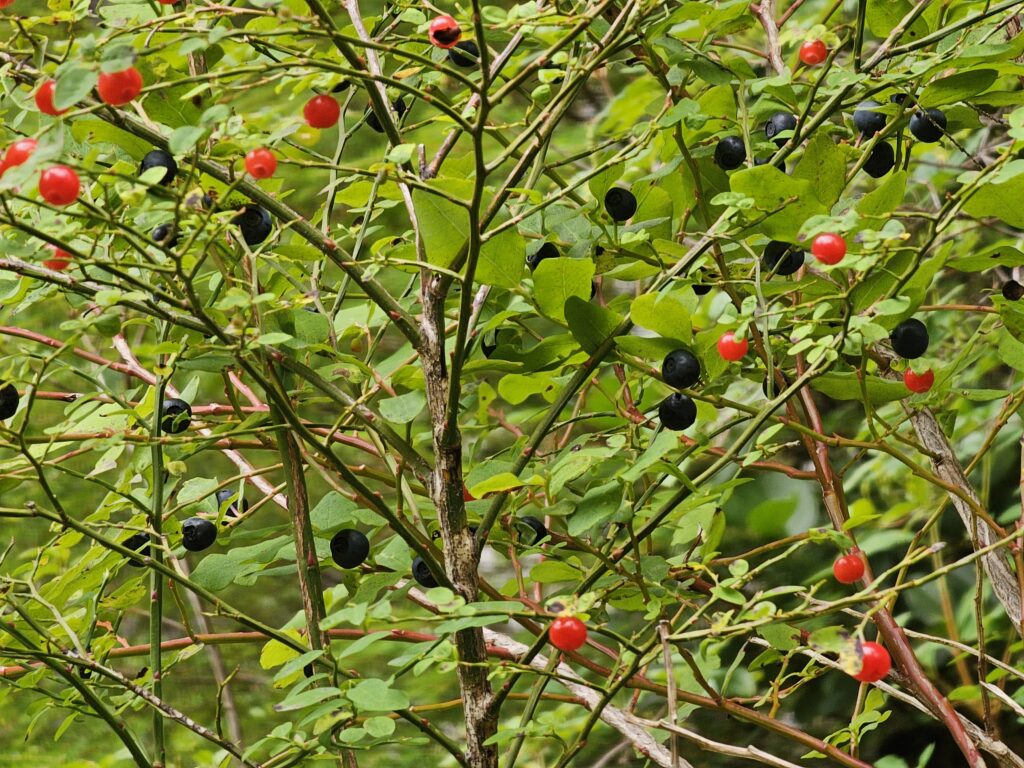
Red and black huckleberries. Two species, two different bushes growing intertwined together. The black huckleberries have slightly larger leaves which have a somewhat more pointed tip and grow to 5 feet tall. Red Huckleberries can grow to 13 feet tall and have bright green branches, the black ones have greenish-yellowish branches.

6 are specifically identified by Doug Benoliel, author of Northwest Foraging: A guide to edible plants of the Pacific Northwest (1974). He identifies red and blue huckleberries (Vaccinium parvifolium and Vaccinium membranaceum, respectively). Other authors call Vaccinium membranaceum a black huckleberry. A third one is bog cranberry (Vaccinium oxycoccos), although others say this is a cranberry, not a blueberry. The fourth is evergreen huckleberry (Vaccinium Ovatum) which lives in the coastal forests, and makes a lovely ornamental plant, as it never loses its leaves. The sixth one Doug identifies is Grouseberry (Vaccinium scoparium), or whortleberry, as being in the blueberry family, but its probably only in the Cascade mountains, not the Olympics. He says that in total, there are 12 species of blueberries in the northwest.
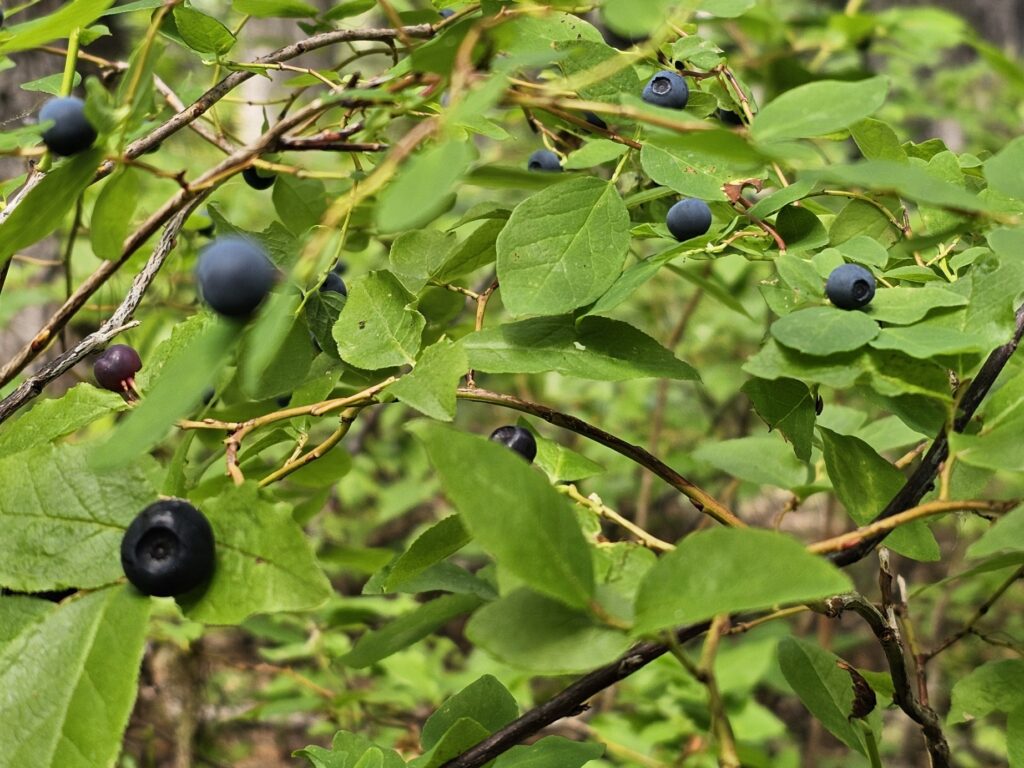
Two varieties of Olympic Mountain blueberries, intertwined in what appears to be one bush
In this picture there are two bushes growing into each other. The dark berries are black huckleberries. Their leaves are a bit more pointy. The lighter colored berries, which have a white-ish waxy covering are Oval-leaved blueberries. If you look closely, you can see their leaves are more rounded, or oval-shaped, and also you can see their bark has reddish-yellowish tinge to it.

8 according Douglas Deur, in his book Pacific Northwest Foraging (2014). He identifies the lingonberry (Vaccinium vitis-idaea) as a type of cranberry, but within the blueberry family. He thinks the bog huckleberry (Vaccinium uliginosum) is one of the sweetest blueberries.

9 according to Mark Turner and Phyllis Gustafson, authors of Wildflowers of the Pacific Northwest (2006). Turner and Gustafson claim there is a Cascades blueberry which has two variants, Vaccinium caespitosum, and the larger variety as Vaccinium deliciosum. Deliciosum is Latin for delicious! (Is that one the best?)

One of the best books to identify Olympic Flowers, and to take hiking (it’s easy to carry), is Charles Stewart’s Wildflowers of the Olympics and Cascades (1988). It’s out of print, but you can still find it on Amazon.com. While he does a nice job with plant descriptions, pictures, and a brief historical note about most plants, and kept his book small for easy carrying, he doesn’t identify every flower or berry. He does identify two Vacciniums. He describes the oval-leaf huckleberry (Vaccinium ovatum). And also what he calls a blue-leaf huckleberry (Vaccinium Deliciosum), his personal favorite.
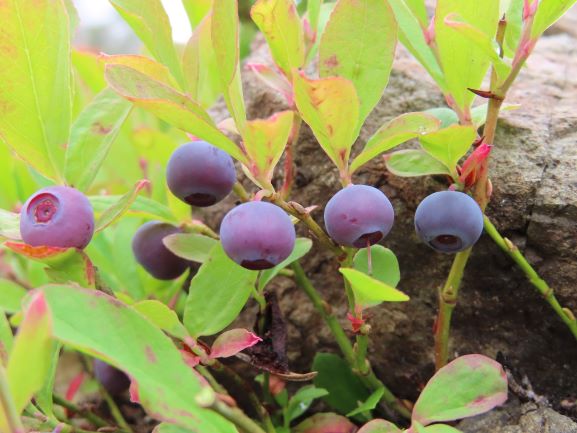
Known as blue-leaf huckleberry, or dwarf blueberry, (Vaccinium deliciosum), these little fellers are good for growing brains, and yummy!

So how many species are there?

8species (and two subspecies with the same common name), according to Pojar and MacKinnon, who seem to have the most technical and comprehensive book. At a hefty 528 pages, their book is Plants of the Pacific Northwest, revised (2014) (10 total authors). It covers Washington, Oregon, Alaska and British Columbia. Here’s their list:

  • Vaccinium alaskaense, Alaskan blueberry
  • Vaccinium caespitosum, dwarf blueberry
  • Vaccinium deliciosum, , blue-leaved blueberry, or Cascade huckleberry, which is very similar to dwarf blueberry
  • Vaccinium membranaceum, black huckleberry
  • Vaccinium ovalifolium, oval-leaved blueberry
  • Vaccinium Ovatum, evergreen huckleberry
  • Vaccinium parvifolium, red huckleberry
  • Vaccinium uliginosum, bog blueberry, and two subspecies Vaccinium occidentale and Vaccinium pubescens, also called bog blueberry
  • (Oxycoccos oxycoccos (sometimes called Vaccinium oxycoccos), bog cranberry, actually a cranberry so it doesn’t make the list for the total number of blueberry species)

And the best blueberry of all?

Pojar and MacKinnon claim dwarf blueberry (vaccinium caespitosum) was the preferred blueberry by indigenous people. It also goes by the common names of Blue-leaved and Cascade huckleberry (and the scientific name Vaccinium deliciosum). The other authors above use one of these names, and they all seem to agree it’s best tasting blueberry. Dwarf blueberry is a good name, in my opinion, because they only grow to a maximum height of about 12 inches tall.
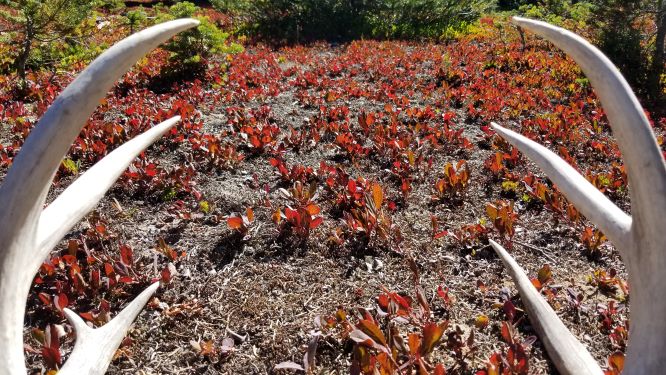
Deer skull and alpine blueberries

For me, the blueberries on the very short dwarf blueberry plants, 2-6 inches tall (in the picture above), are the best of the best. I’m going with the scientific name Vaccinium deliciosum because they are deliciousis, the sweetest of all! Maybe this is because they have been “pruned”, or eaten down, by the deer and bear, and perhaps their root systems are much larger than the plant. If so, it could be that these shorty plants can concentrate a lot of energy from their root systems into a few berries packed with a lot of fruit sugar.

The second runner up might be the black huckleberry (Vaccinium membranaceum). This tasty berry is not only sweet when fully ripe, it’s very juicy and one of the largest wild blueberries.

However you count them, there’s a lot of wild blue-black-red-orange Vaccinium berries up in them there hills. Most become ripe in July, August, and September (depending on variety and elevation). Finding, identifying, and eating wild blueberries is a great nature experience for kids, and an excellent SNACCMS activity for building moral fiber.

Cautionary notes:
Ripe berries are pretty easy to identify as being in the blueberry family once you get a sense of what a blueberry bush is like. All the blue and black berry varieties taste like a blueberry. To be certain, the best way to identify edible plants is usually by the flower description, using a good guide book. Charles Stewart’s and Doug Benoliel’s books are easy to slip into a day pack.

On the dwarf blueberries, especially the 2-6″ shorties, you’ll often notice deer and bear scat near these plants, so there may be a risk these berries have been exposed to other animal excrements. Washing before eating might be advisable.

Bears love them too

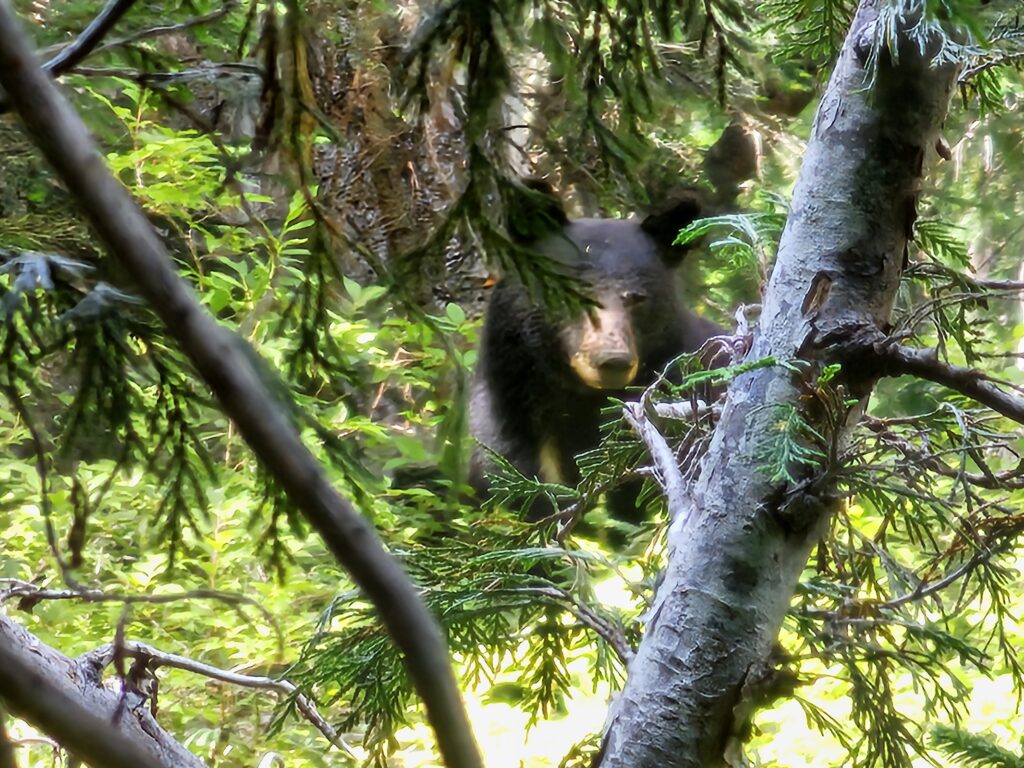
When ripe, black bears of the Olympics seem to eat nothing but blueberries. At least according to their scat.
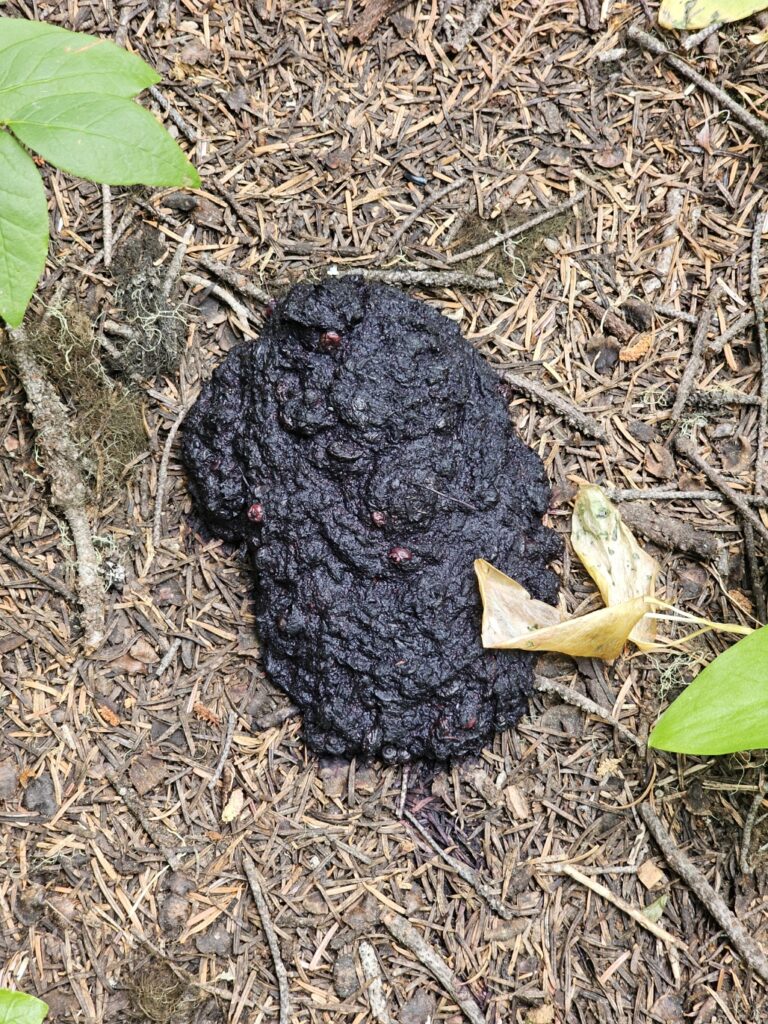
When these “blueberry poops” dry out, there’s nothing much left.
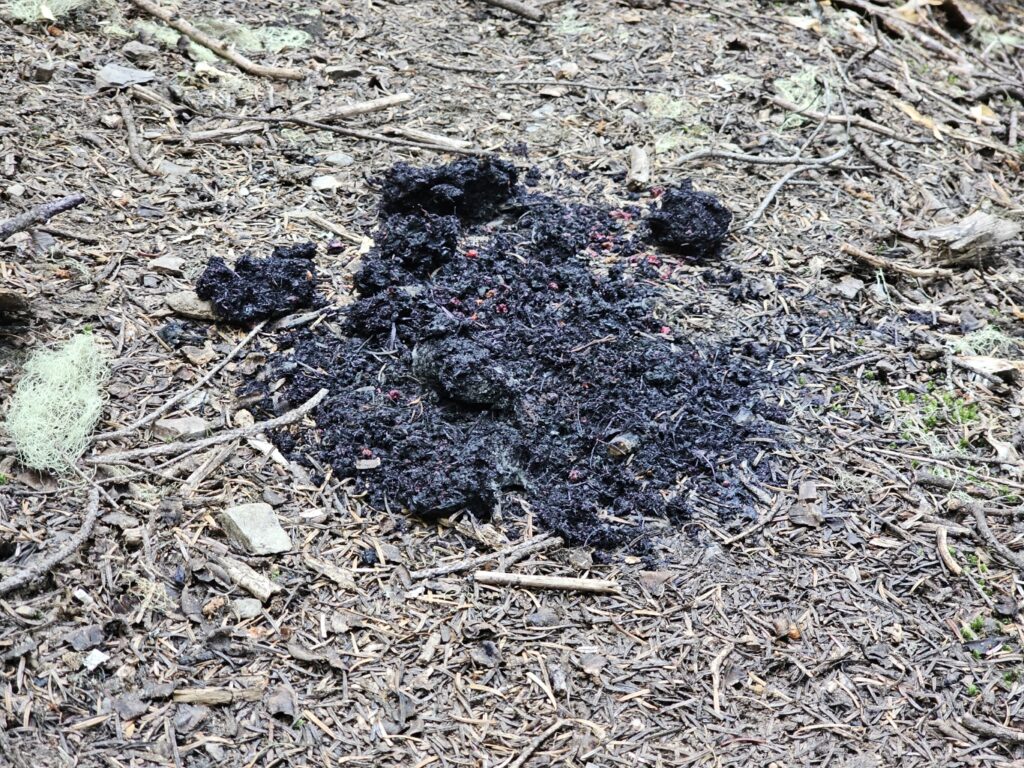
Be mindful of the black bears when you go to hunt for blueberries. Black bears are afraid of humans so they tend to run away if they see you. There are no grizzly or brown bears in the Olympics, which are definitely dangerous bears. We only have black bears.
What do you think? How many species can you find? Which one do you think is the sweetest. Drop us a note with your thoughts.

Law is an important service to the health of our community. Parenting is even more important.

By Mark Baumann
This article is a ClallamCountyBar.com local feature article.
Filed Under: Local feature articles, Nature on the Olympic Peninsula, SNACCMS

Jellyfish swarm in Port Angeles Harbor

November 17, 2024

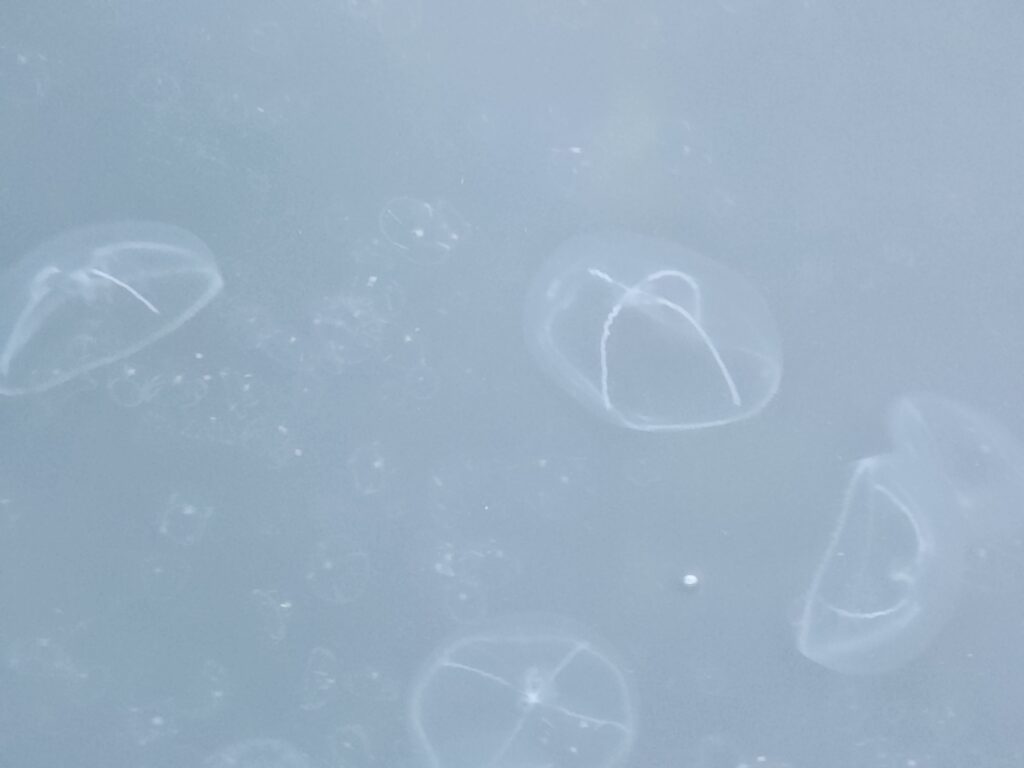
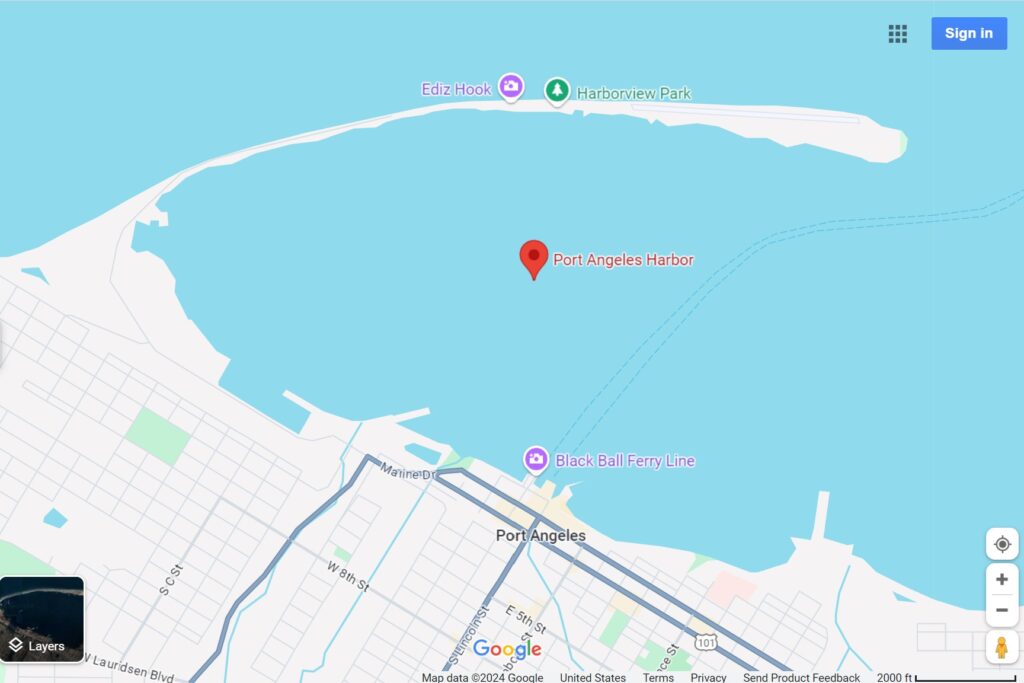
A jellyfish swarm, also known as a bloom, smack or mass aggregation, occurred in Port Angeles Harbor on Friday, November 15, 2024. Several jellyfish species, and similar jelly-like but not jellyfish species called salps, were sighted pouring into the harbor alongside the inner tip of Ediz Hook. Jellyfish are also known as sea jellies. The number of jellies in this smack is unknown, but likely ranged from hundreds of thousands to over a million.

Jellies and salps are both simple and amazing creatures. They appear in large groups and as solitary animals. Jellies only have one body hole (for mouth, anus, and reproduction). Jellies swim and salps have jet propulsion. They navigate. They hunt. Jellies have spring loaded and poison tipped barbed darts. They eat anything that will fit in their hole. They have a unique life cycle and reproduce through multiple methods. They are sensitive to climate change and they have replaced whole fisheries in some parts of the world.

Adult and juvenile cross jellyfish in Port Angeles Harbor November 15, 2024
Cross jellyfish, juvenile and adult

Jelly swarms (blooms, smacks or aggregations)

Jellyfish swarms are increasingly common in the Puget Sound, and have recently been the subject of study by the Washington State Department of Ecology (DOE) in 2014-2015. It’s hard to count the total number so aggregations are measured by “mass category,” which ranges from a mass size of 1 to 5, where 5 is the largest. Mass size tends to be larger in late summer-fall. In November, mass sizes counted have ranged from about 2.2-3.8. A jellyfish smack can “easily exceed hundreds of millions of individual” animals in an individual Puget Sound finger inlet, such as Budd Inlet.

Jelly and other species observed in the PA smack

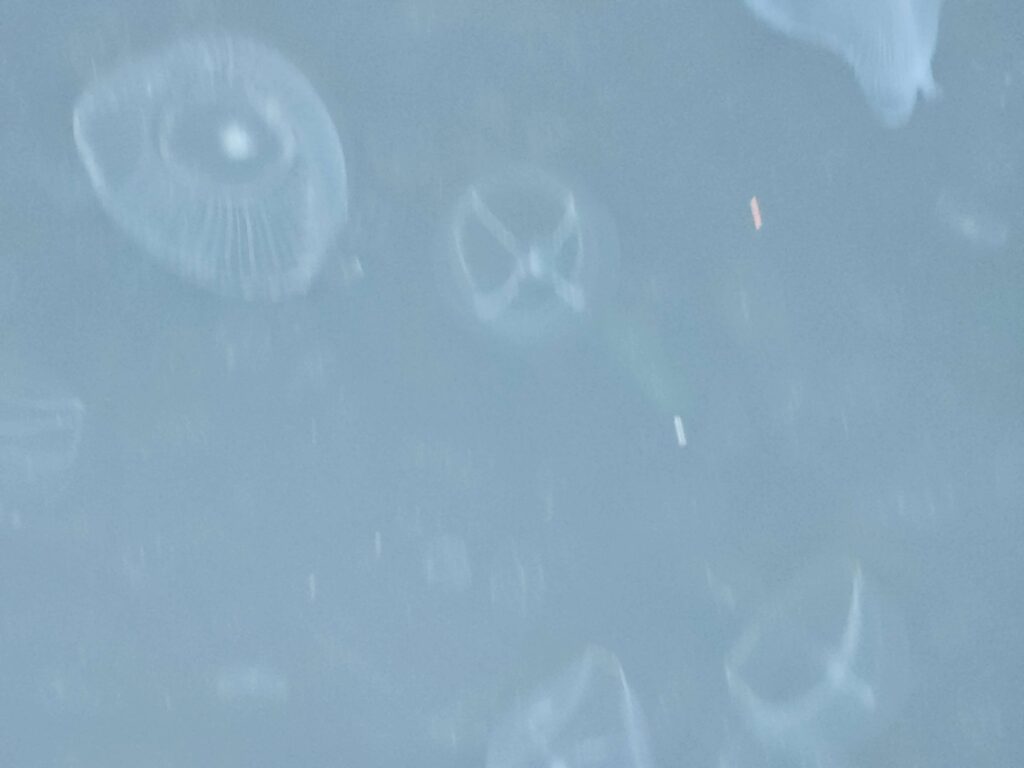
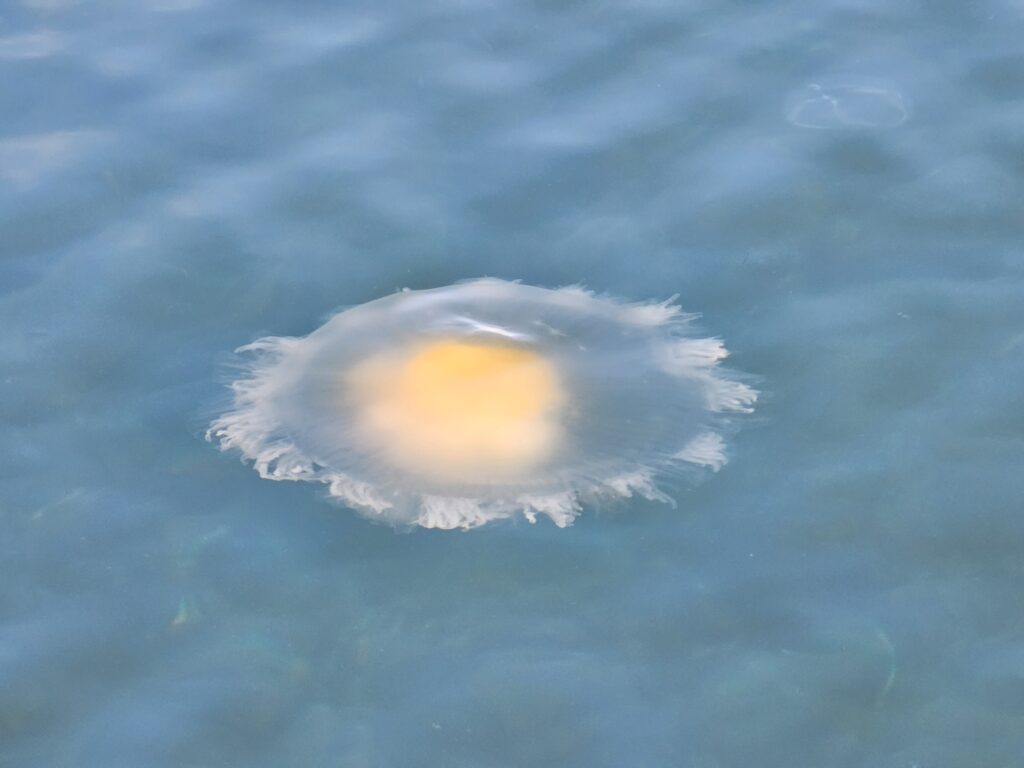
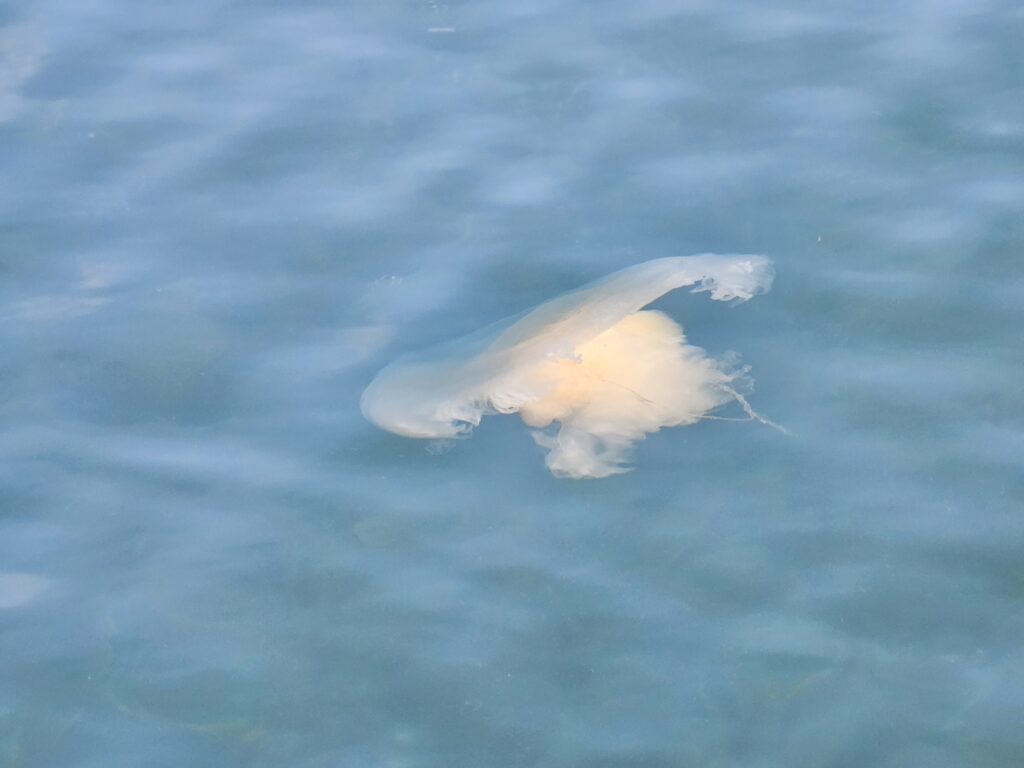
Several observers predominately saw cross jellies, both younger and older adults and juveniles. Also seen were crystal jellies, moon jellies, egg yolk jellies, box jellies, water jellies, and beautiful and stinging pacific sea nettles. Salps and sea lice were also seen.

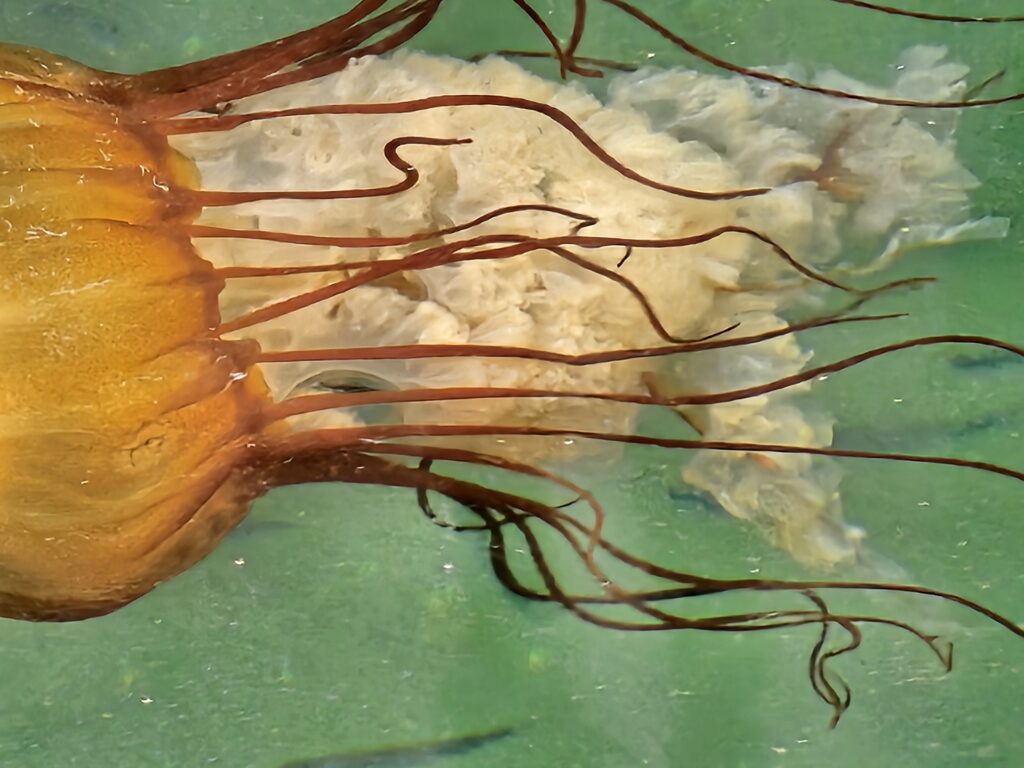
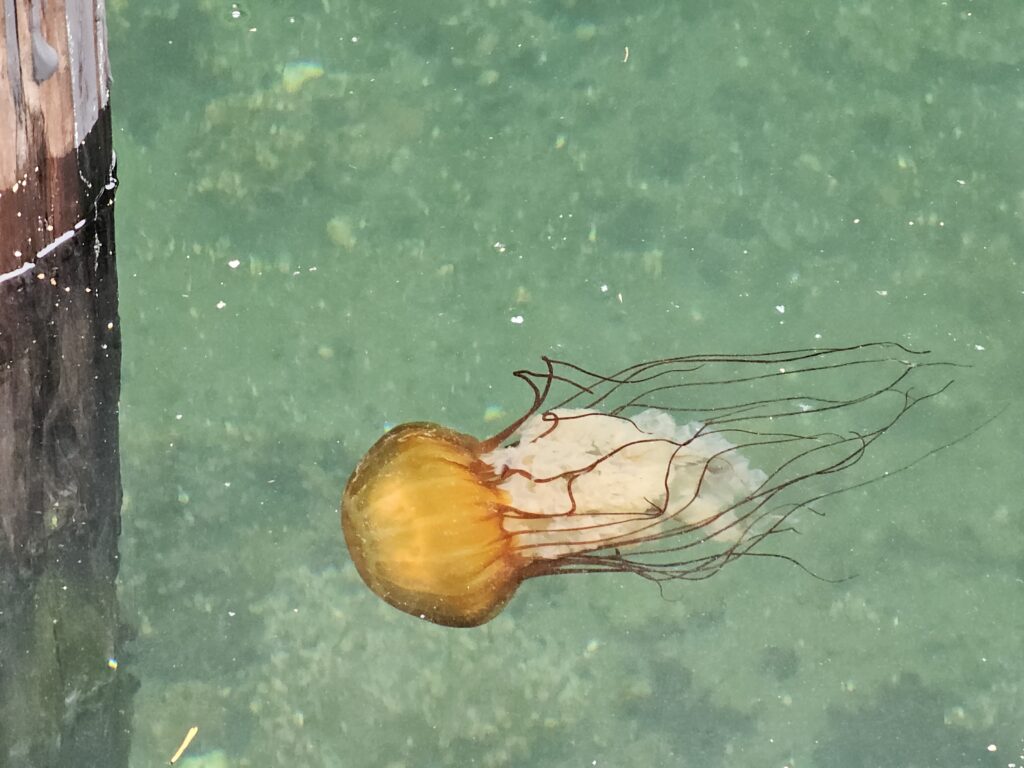
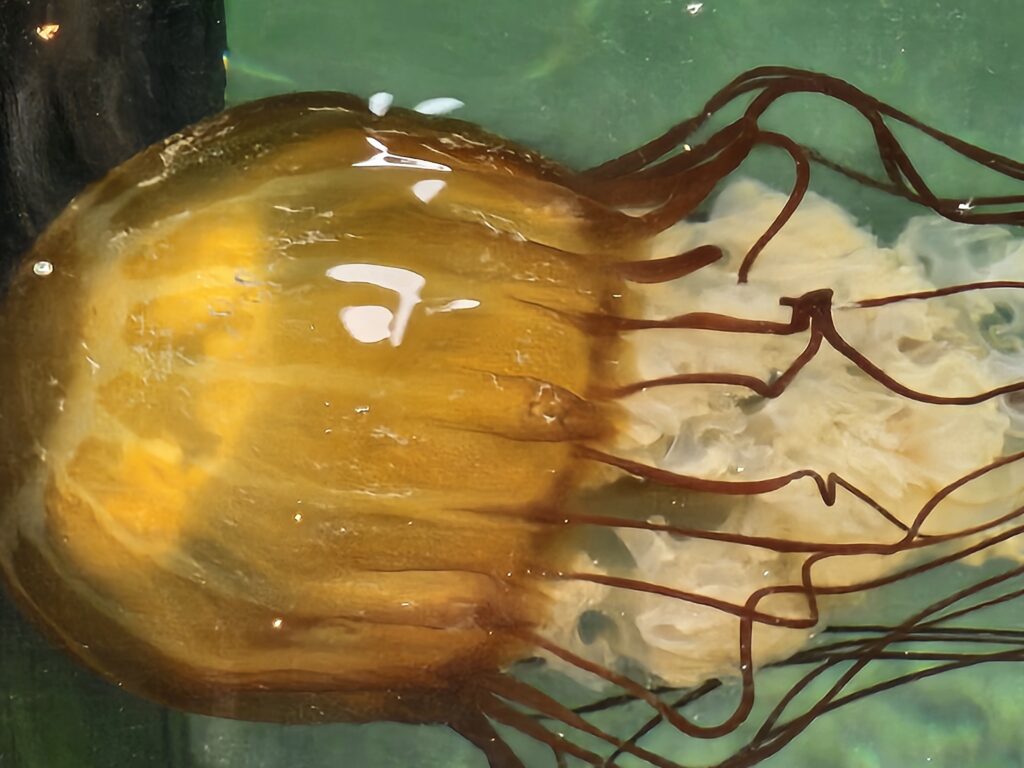
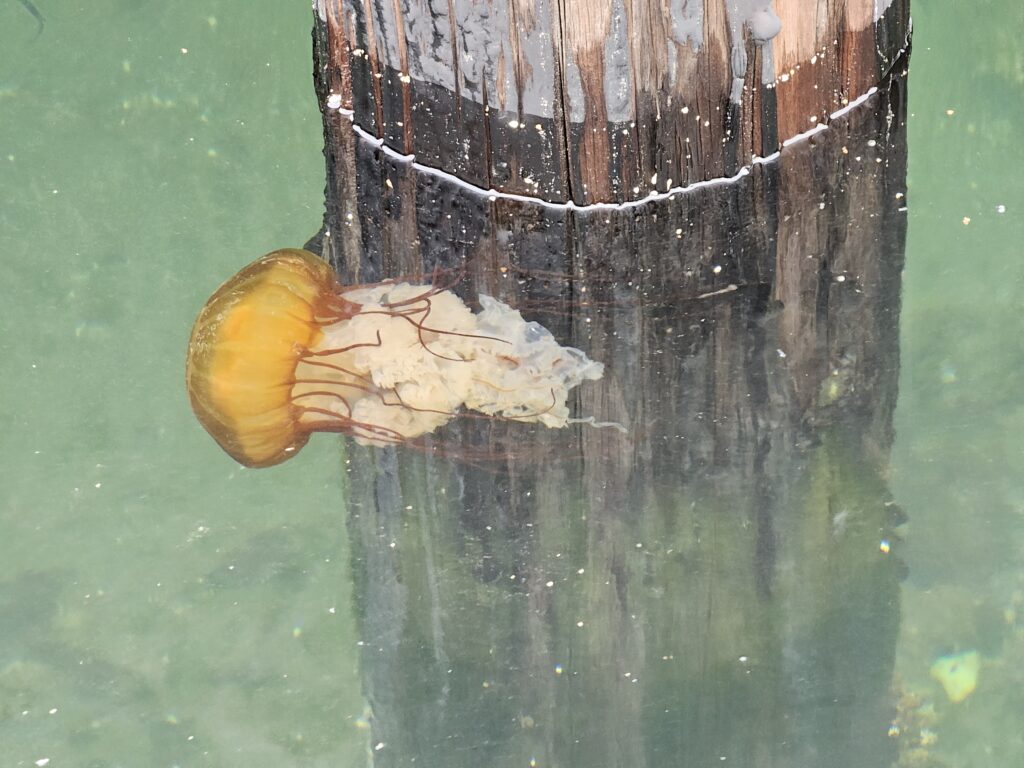
Pacific sea nettle
Water jelly and cross jellies both adult and juvenile
Crystal and cross jellies
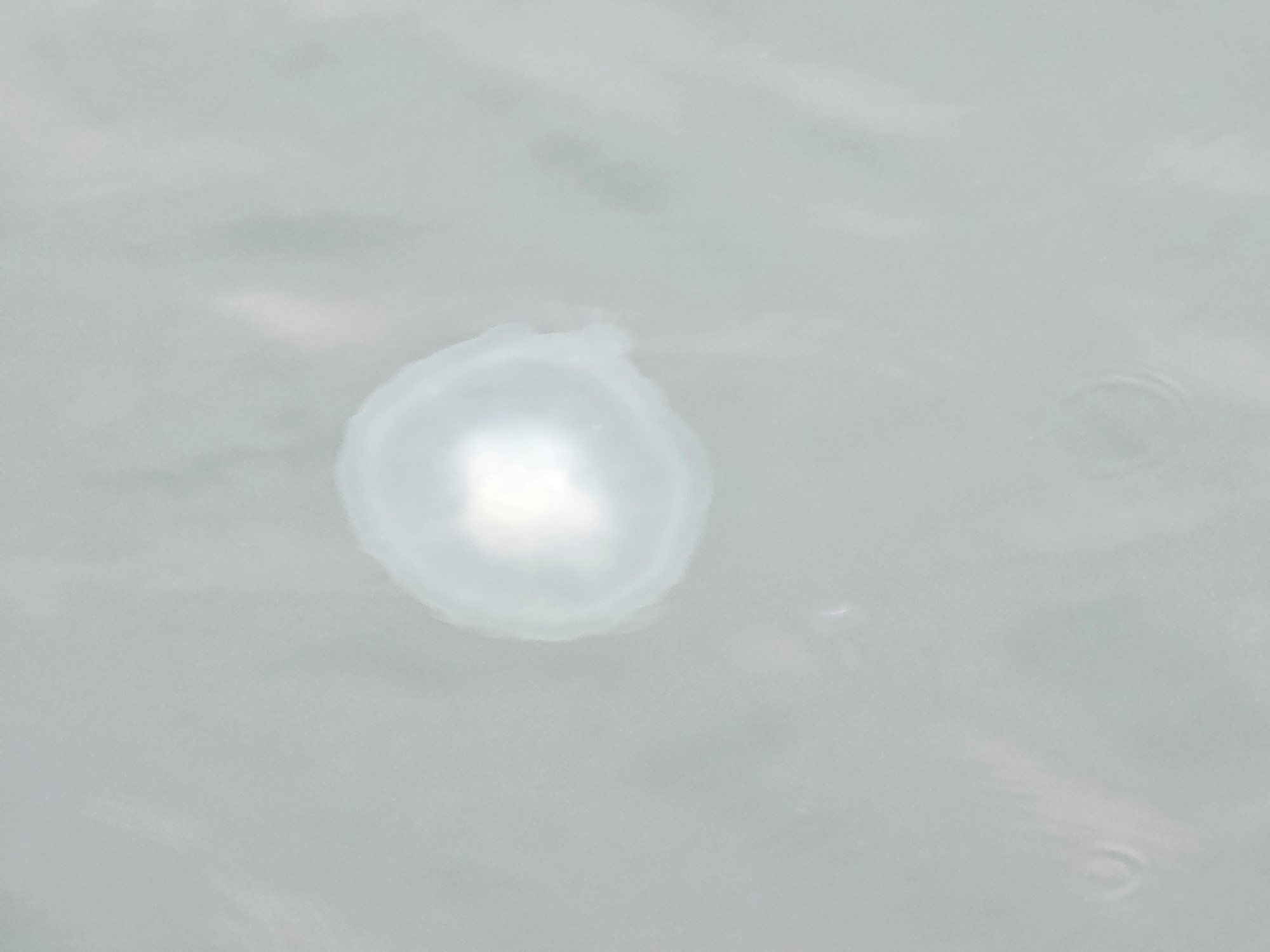
Moon jelly in Port Angeles Harbor during November 2024 swarm
Moon jelly
Egg yolk jelly
Egg yolk jelly
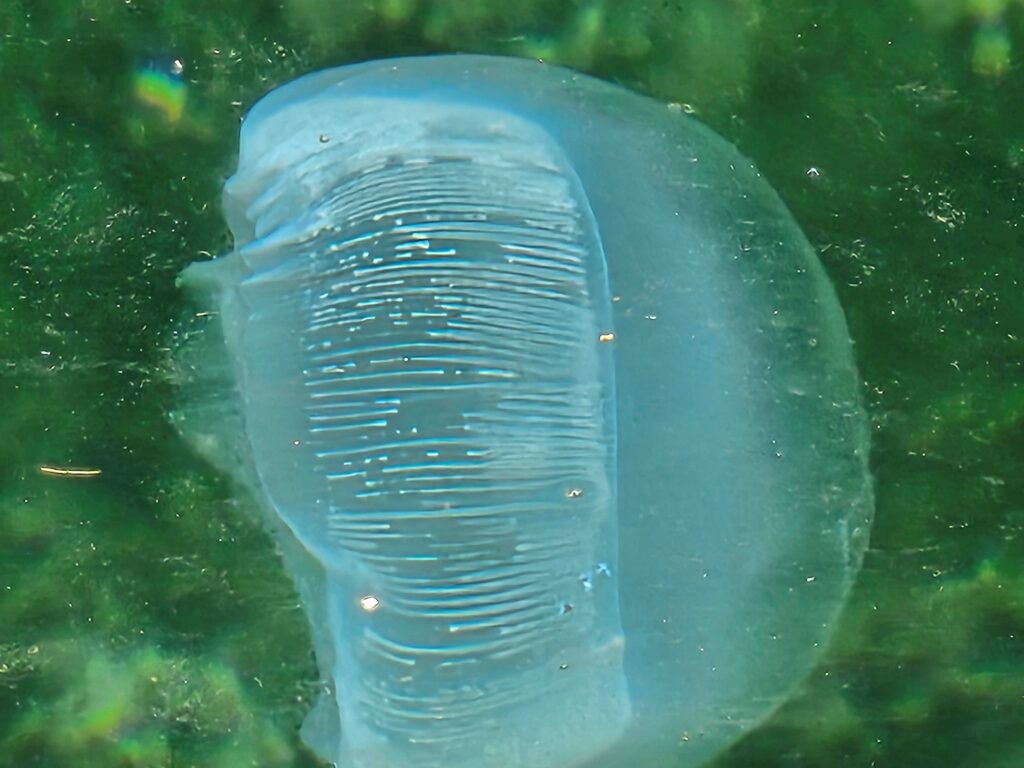
Crystal jelly

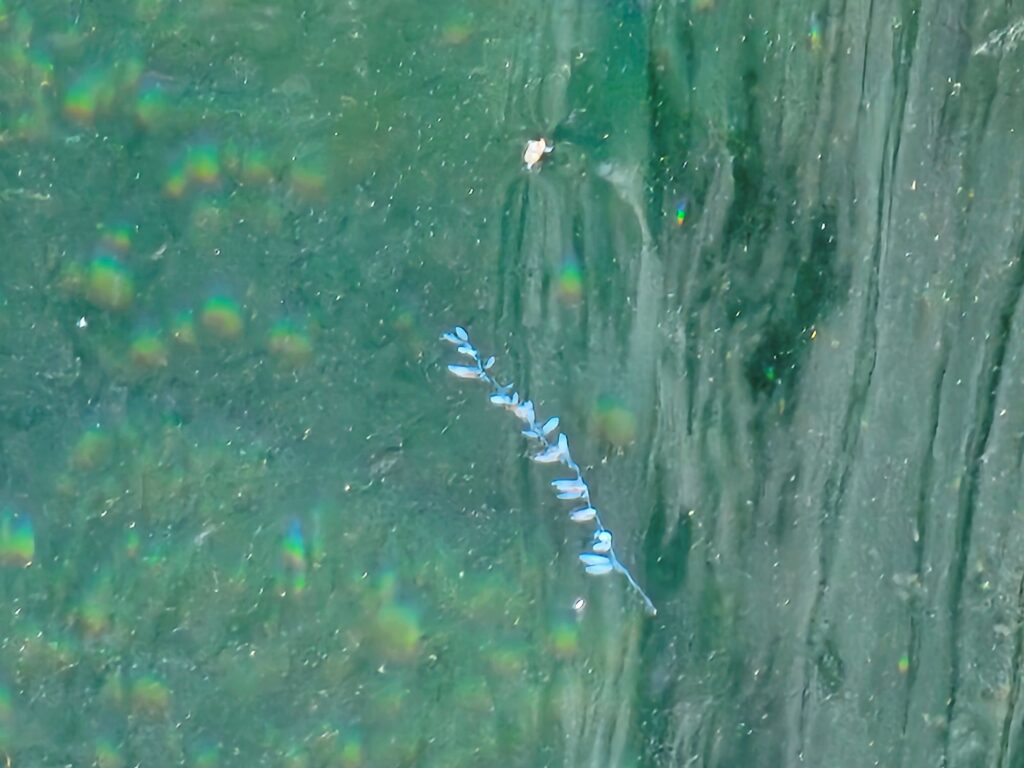
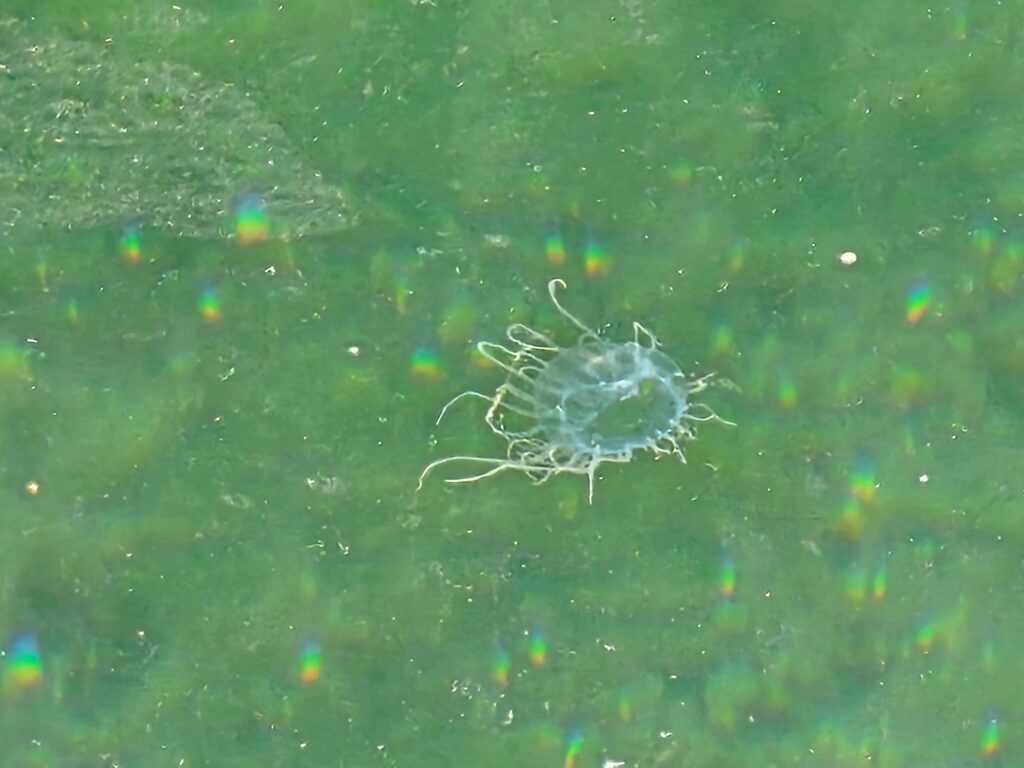
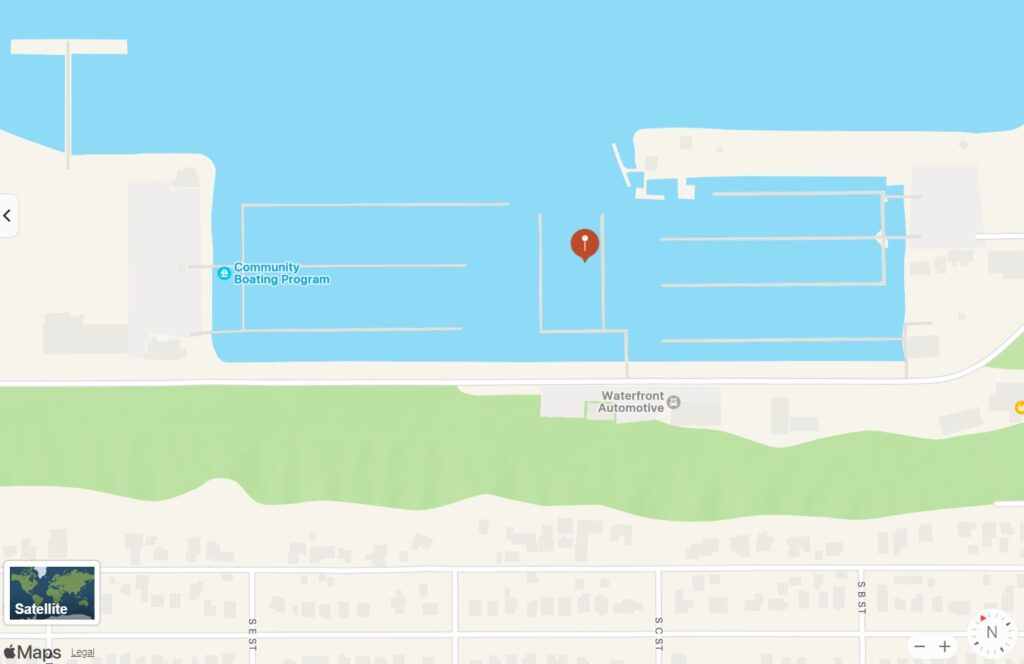
Some jellies were hard to identify. I don’t know what the string critter is (picture below left), do you? It definitely had propulsion and was able to move against the current in the marina. An observer from New Zealand said they called them sea lice and that they sting as they wrap around you. The Feiro Marine Life Center thought it might be Siphonophore, which is a subgroup of Hydrozoans, which is a subgroup of the Cnidaria phylum. Cnidarian’s includes corals, true jellyfish (Scyphozoa) and Hydrozoans. The critters in the Cnidaria phylum all share in common a decentralized nervous system (no spinal chord) and stingers (described below).

A jelly like critter but in a string shape
What is this critter? A type of Siphonophore?
Unidentified jellyfish in Port Angeles marina
This is likely a Polyorchidae, possibly a red eye medusa (Polyorchidae penicillatus, a hydrozoan not a true jellyfish)

175 species of Siphonophores have been identified. They are not a single critter, but a complex colony of organisms each contributing uniquely to the colony’s survival and reproduction.

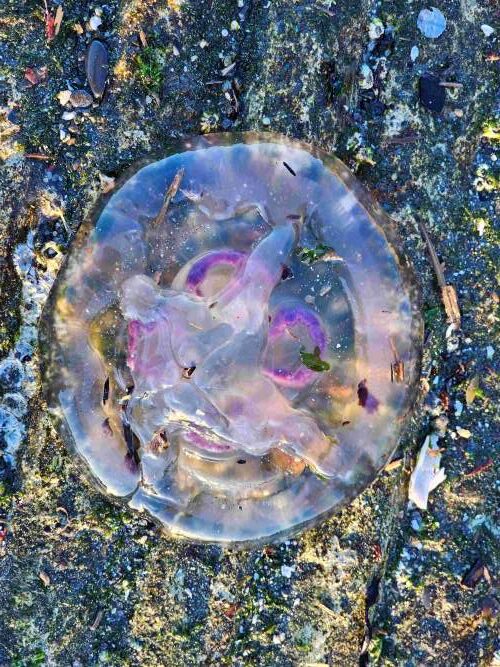
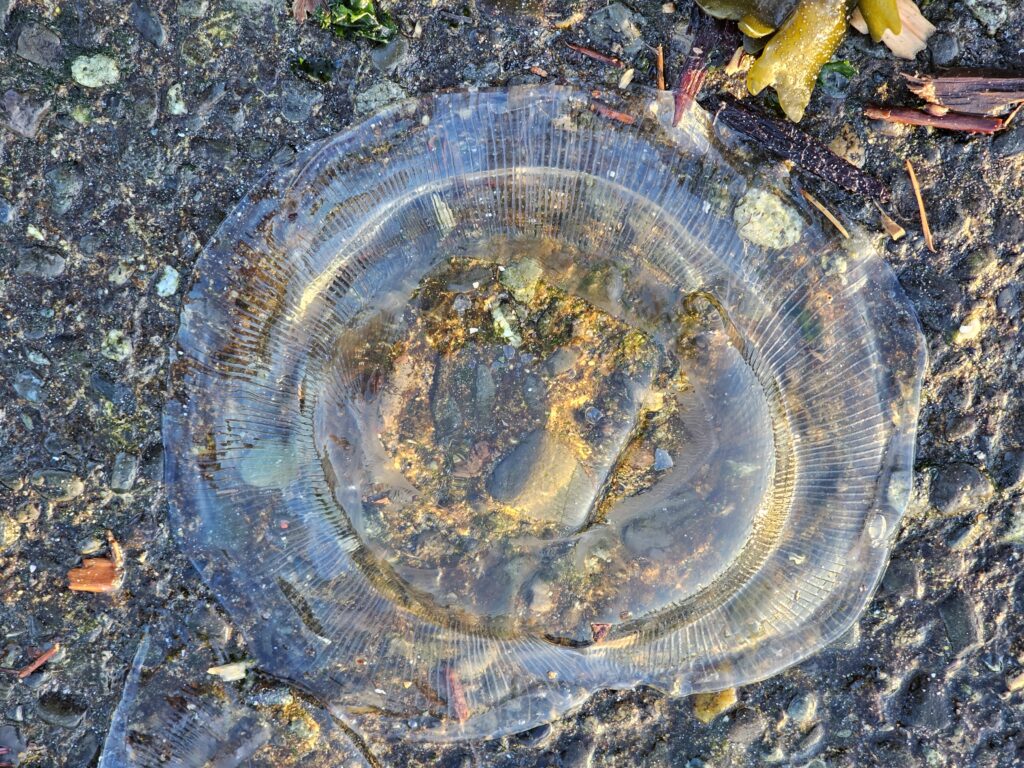
There were quite a number of deceased jellies washed up on shore after the morning high tide on Friday, November 15, 2024, such as the moon jelly (below left) with the C-shaped purple sex organs. The crystal jelly’s ridges (below right) under the outer bell are rigid like a washboard.

Moon jelly, dead on shore, with C-shaped purple sexual organs
Moon Jelly, ashore, with C-shaped purple sexual organs
Crystal jelly washed ashore on Ediz Hook, Port Angeles
Crystal jelly washed ashore

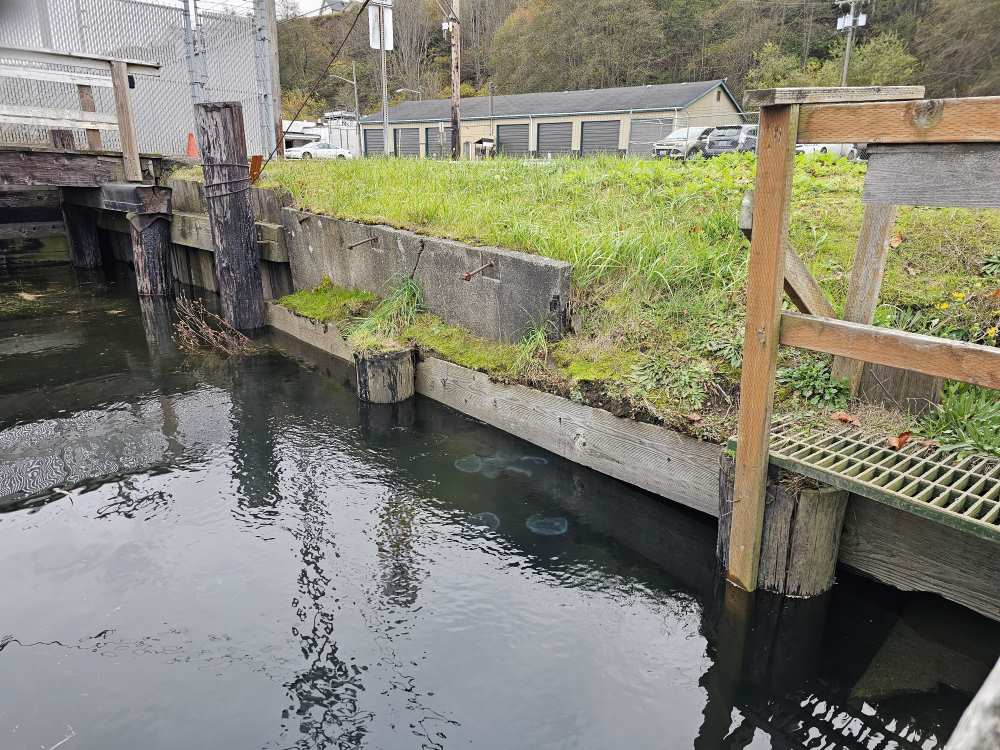
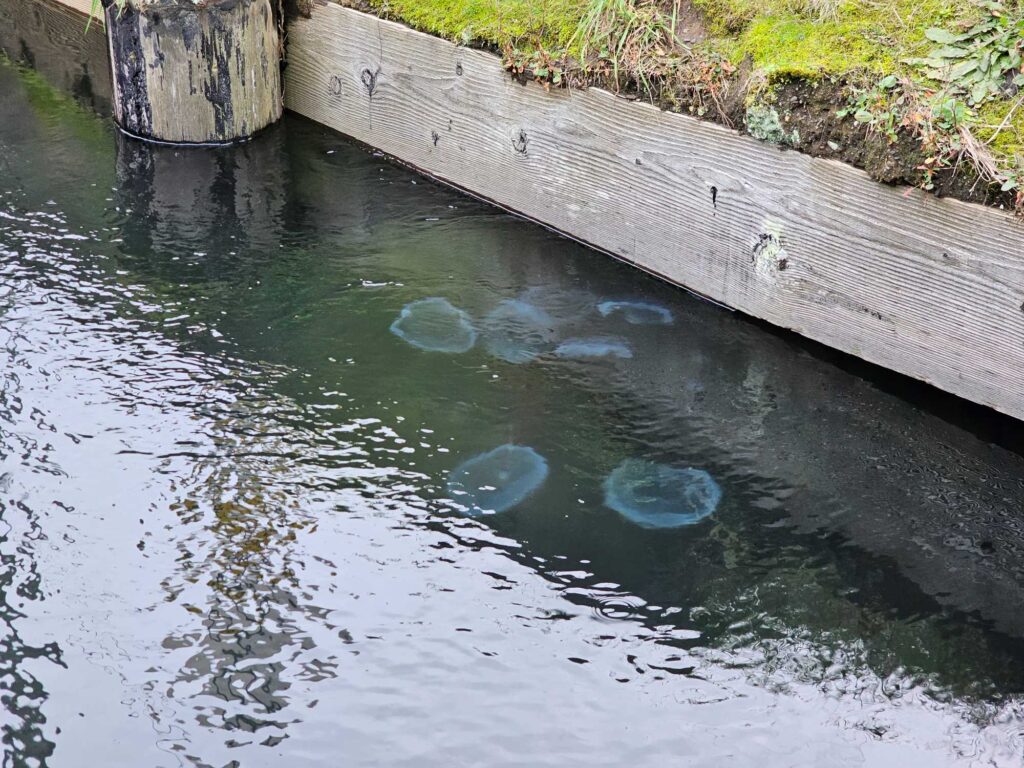
The next day, Saturday, November 16, 2024, a few jellies were seen in all parts of the harbor. They were also seen inside the Port Angeles Boat Haven (marina), but not in mass quantities. One small exception was the collection of crystal jellies in the pictures below. Interestingly, these were hovering at the tail of a freshwater outlet pipe. The water flow from the pipe was substantial, and clear, and the jellies were fighting successfully to stay close to the pipe outlet. But why?

Crystal jellyfish in the Port Angeles Boat Haven congregated at the mouth of a freshwater outlet pipe
Crystal jellies
Crystal jellies at freshwater outlet pipe

Salps

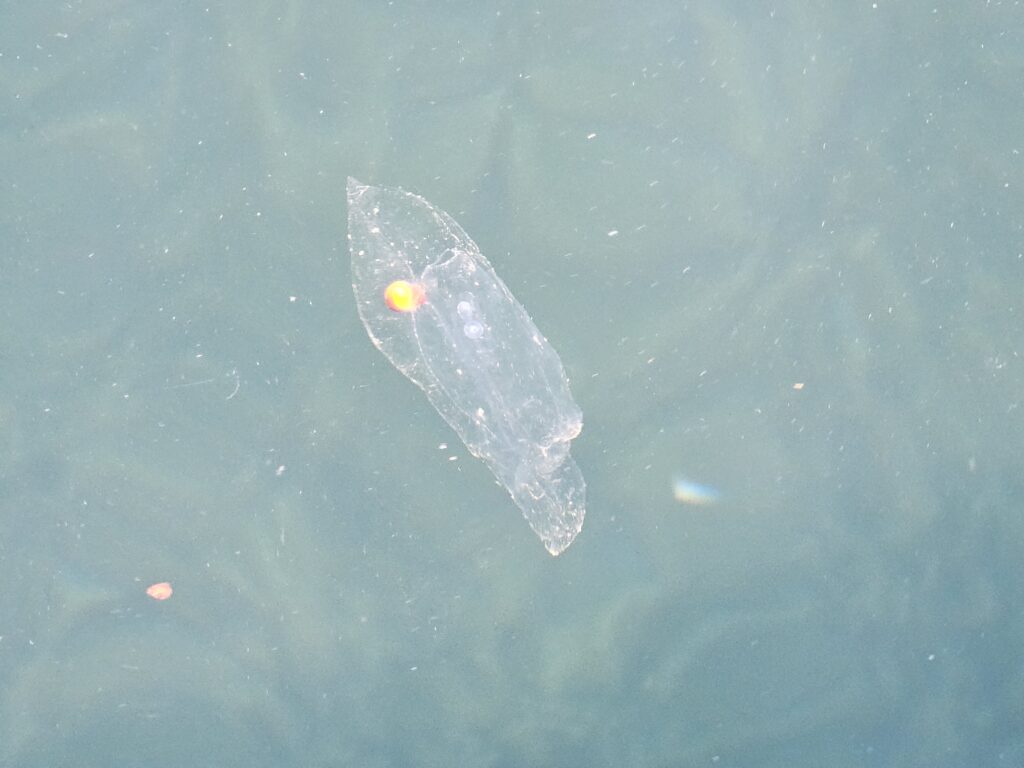
Salps were seen in abundance in the November 15, 2024 Port Angeles Harbor smack. Salps are not jellyfish and not even related. They have a spinal chord, which makes them related to humans and all vertebrates.

This is a salp, not a jellyfish. It shares the characteristic of a clear body, but is barrel shaped and has a dorsal nerve chord so it is related to vertebrates.
Salp, not a jellyfish
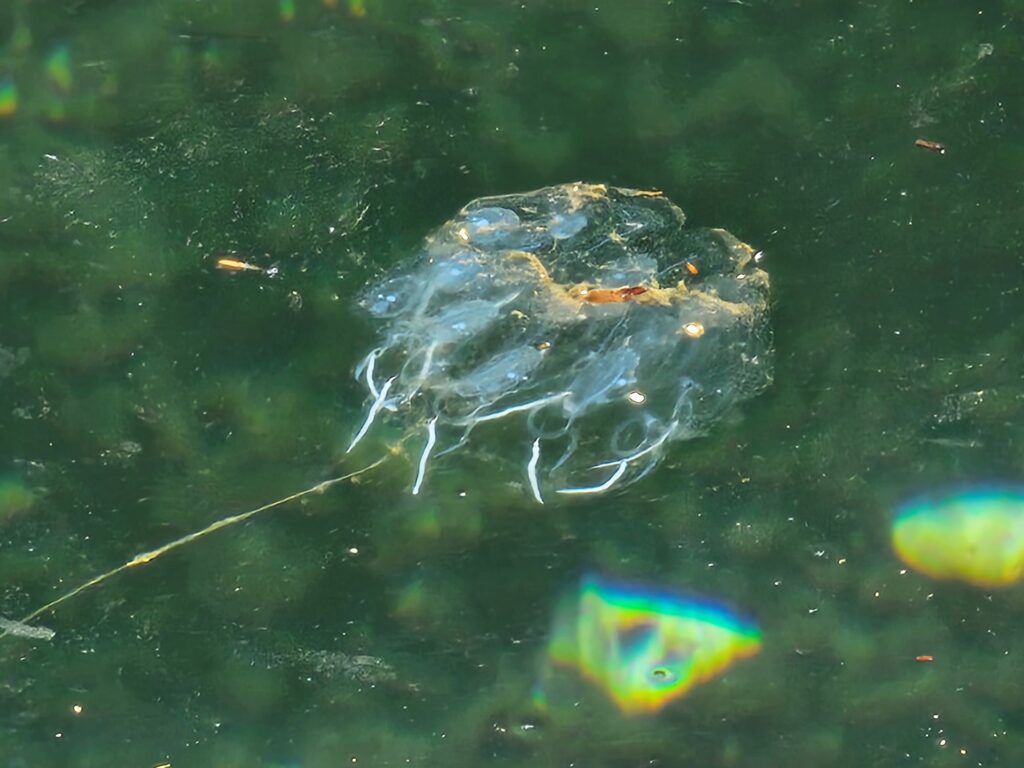
Unknown type of gelatinous sea creature, may be a colony of smaller critters
Likely a Cycloscalpa Bakeri species, a ring colony of individuals as seen left

Salps live in two phases. The first is as a single organism (picture above left), and the second is in a colony (picture, above right). Can you see a second single salp in the picture on the left? (Hint, the second yellow dot is part another single salp lower in the water.) According to the Feiro Marine Life Center, the animal on the right is likely a colonial salp of a Cyclosalpa species. Salps are best known in the colony phase. If you search the internet, or read the Wikipedia page for salps, you’ll see lots of pictures of salp colonies. One such picture in the Wikipedia article is a circular ring cluster of pelagic salps in New Zealand, which looks very much like the salp colony in the picture above.

Salps do not have tentacles nor a stinging mechanism. The white filament, or ribbon, is a stolon which only appears on the aggregate-colony form of a salp, and it’s function is to clone babies. They collect and eat phytoplankton with a mucous net inside their jet propulsion tube. You can just barely make out the tube structure in the picture of the single salp, above left. Very small fish can swim into and hide inside the salp tube, effectively cloaking themselves with an invisibility shield. (I’m not sure if that tickles the salp, what do you think?)

What is a jellyfish?

They are surprisingly interesting animals, both extremely simple and complex. The have no blood, no heart, no lungs, and of course no bones. They have no brain, although they have a nervous system which senses and responds to the environment.

Jellyfish eye

Some species have a more evolved nervous system and a rudimentary eye. In some species the “eye” is very simple and only senses for light. In other species, particularly the box jellies, they have a more evolved structure clearly identifiable as an eye which they use to move toward or away from light and also to navigate around obstacles. Depending on the box jelly species, they have 1-4 eyes, and at least one species has 24 eyes.

One body hole

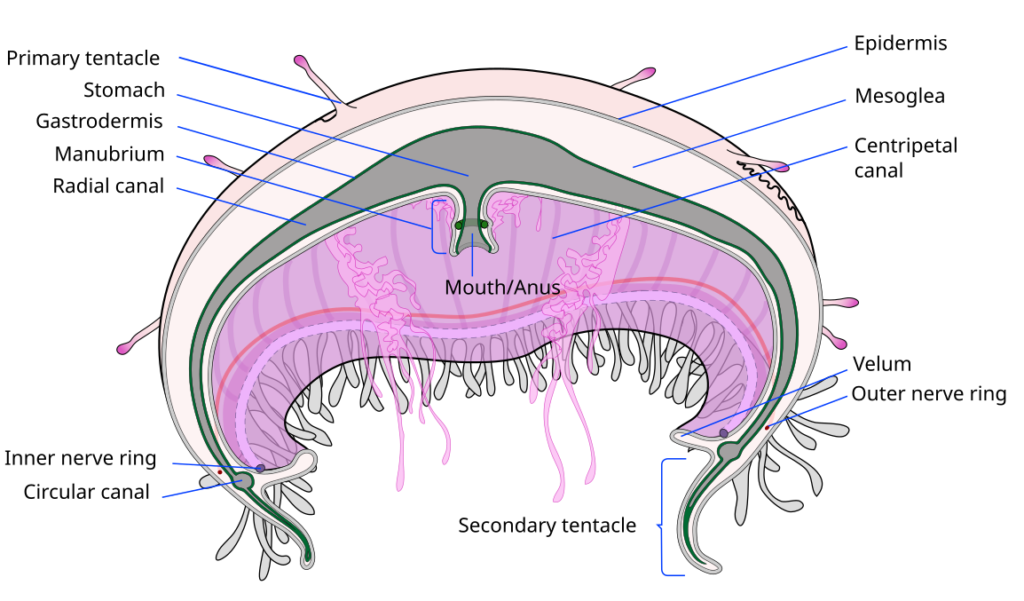
A jelly has one hole: the mouth is also it’s anus and entry/exit way for the sexual organ. Yes, it eats and poops and delivers and receives sperm and eggs from the same hole.

By Mariana Ruiz Villarreal (LadyofHats), public domain copyright, from https://en.wikipedia.org/wiki/Jellyfish#Anatomy

Some jellyfish facts

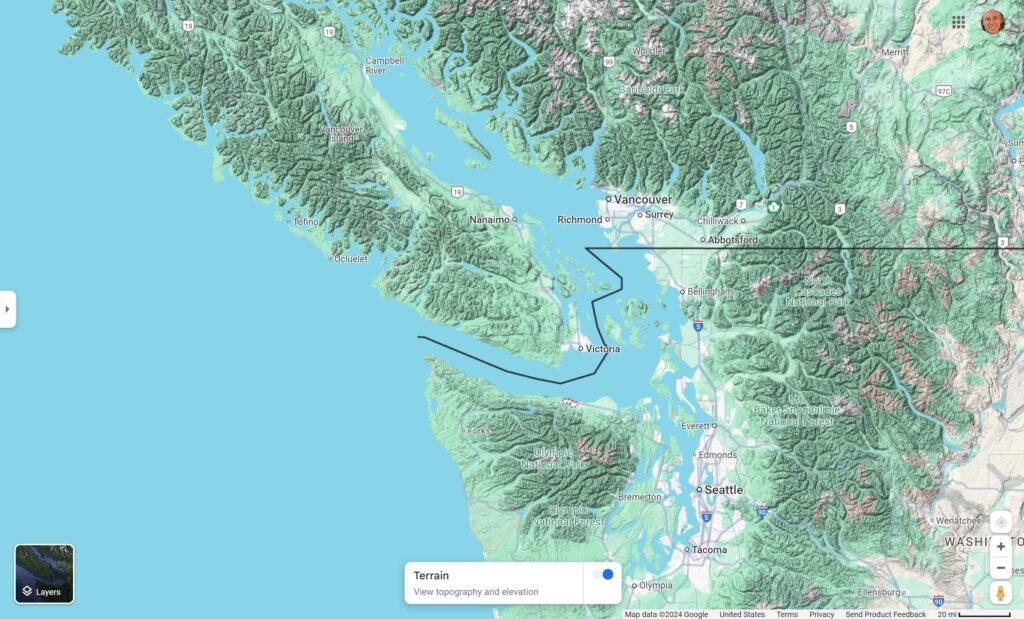
Map of the Salish Sea, which includes the Strait of Juan de Fuca, Puget Sound in the USA, and the Strait of Georgia and Desolation Sound in Canada
The Salish Sea, ranges from the mouth of Strait of Juan de Fuca, south to Olympia, WA, and north to Desolation Sound, BC.

There over 2,000 jelly species. The bell height and diameter ranges by species from 0.5 millimeters (1/32 inch) to 2 meters (6.5 feet). Their tentacles can range from 1 inch long to 119 feet long. The lion’s mane jelly is the longest, longer than any whale, and may be the longest animal on the planet. Lion’s mane jellies live in the Salish Sea, although they are not reported as growing that large here.

They can release as many as 45,000 eggs daily.

Their diet is varied and includes plants and animals tiny to small: protozoa, phytoplankton (plant), plankton (animal), zooplankton, rotifers, eggs, crustacean larvae and grown crustaceans, larval fish and small fish, and other jellies. Each species eats different things, but most or all are carnivorous. Some eat whatever attaches to their tentacles and fits in their mouth, so any kind of small creature.

Jellies swim, and navigate

Jellyfish are considered by most as planktonic, in that they float with the currents. But, they are not simply passive creatures subject to the whims of currents, they have the power of locomotion. Typically they move about 1.5 meters (5 feet) per minute, and some can travel up to 4 meters (12 feet) per minute. They can move in any direction including against the current. Some species, like the pacific sea nettle can move up and down the ocean’s water column 1100 meters (3,600 feet) per day. Yes, per day!

Since they never stop swimming, even at a leisurely 1.5 meters per minute, they can travel 2,200 meters (7200 feet, or 1.36 miles) per day. Presumably, that can be extended or offset depending on how they navigate currents and whether or not they choose to stay in one location for a while.

I watched this pacific sea nettle in the gallery below swim around in the Port Angeles Boat Haven on November 16, 2024. I first saw it swim (west) past the wood pier, which was up-current. It then turned 90 degrees and swam to the left (south), bumped into a wooden bulkhead, turned around 180 degrees and swam north past that pier post, and then again west, where it bumped into a cement pier. Despite the current wanting to push it east, it stayed in a very small area for at least 15 minutes.

Two types of tentacles

The long stringy tentacles are the true tentacles and contain all or almost all the stingers. The other kind are called oral arms, which assist with collecting food and bringing it to the mouth inside the bottom of the bell. The oral arms can also hold a brood of baby jellies (called planula). For the pacific sea nettle jelly (above), the red strings growing out sides of the bell are the tentacles and the lighter colored mass that flow from the middle of the bell are the oral arms.

Sometimes the tentacles are hard to see. For many of the cross jellies, pictures above, it was hard to see if they had tentacles. Crystal jellies don’t appear to have tentacles, because they don’t. They aren’t actually jellyfish, although they are closely related. Crystal jellies are in the Hydrozoa class of the Cnidaria phylum, and jellies are in the scyphozoa class of Cnidarians.

Sometimes the tentacles are translucent or fine like a hair, and difficult or impossible to see.

Jellies hunt with poison tipped spearguns

Jellies can sense their prey and move towards it. They hunt!

Jellyfish are voracious hunters. Their vortex-creating swimming action can also draw in food to the tentacles and they never stop swimming or eating.

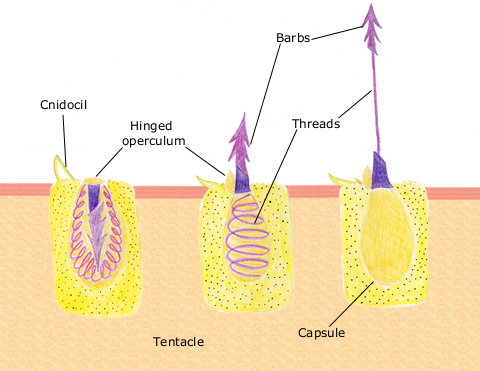
The barb system is called a nematocyst. Upon contact, many poison filled barbs shoot out like a bank of harpoons piercing the skin where neurotoxins are injected. From the Wikipedia article on jellyfish, the original uploader was Spaully at English Wikipedia. – Transferred from en.wikipedia to Commons., Public Domain, https://commons.wikimedia.org/w/index.php?curid=2909974

Jelly tentacles have an amazing weapon. Each tentacle is loaded with many, sometimes millions of spring loaded barbed harpoons filled with a neurotoxin. These weapons hide in a tiny cyst cavity just beneath the surfaces of their skin. The lion’s mane jelly can have 1,200 tentacles, some up to 119 feet long, covered in cysts containing the barbed hooks. These weapons are scientifically called cnidocytes.

Jellyfish are in the Cnidaria family (the C is silent, it’s pronounced ny-dar-ee-uh), which includes jellies, corals, anemones and hydroids (tube forming polyps with tentacles). All species in the cnidaria family have these attack cells, although the level of toxin varies by species. This attack cell, has a small hair like structure on the outside that is triggered by contact or chemical presence. Inside the cell there is a chemical which facilitates water rushing quickly in once triggered, and the cell “door” opens and water jets back out carrying the barbed hook. The cell is triggered and the barb is released in a split second with an explosive amount of pressure.

Different members of the cnidaria family have different types of attack tools, which may not have a barb at the end of the attack string. Instead, the launched string can either wrap around the prey, or stick to it. Some anemones, like the starlet sea anemone on the U.S. east coast, has all three kinds of attack methods. The sticky-Velcro feeling you get when put your finger in a Salish Sea anemone may be from the sticky attack strings, or from barbs ripping off the top layer of your skin.

Cnidarians, including jellyfish, have the intelligence to know if something they touch is potentially prey or not, which is why they don’t sting themselves. Although they can’t tell if a human is prey or not, which is why they sting us.

Most Cnidarians in the Salish Sea have very mild poison in their barbs. When these creatures don’t need to eat larger prey, they don’t need strong poison. According to the Feiro Marine Life Center in Port Angeles, moon jellies toxic sting is so mild humans don’t notice it, unless their skin is sensitive or they are allergic.

Lion’s mane and pacific sea nettle, Salish Sea jellies, carry enough neurotoxins to cause pain, but not death, to humans.

The Portuguese man o’ war is renowned for it’s painful sting (although it’s not technically a jellyfish, it’s a hydrozoan, like the string critter above), but the Australian box jelly is the most deadly jelly. It’s one of the most poisonous creatures on earth and can kill a human in a matter of minutes if medical help isn’t received. It’s poison was analyzed to include an amazing cocktail of 170 toxic proteins. (The application of diluted vinegar can ease the pain from the stings of some jellies, including the Australian box jelly. Some Australian beaches stock emergency beach kiosks with vinegar.)

Some fish are immune to the poison of some jellyfish, and they’ll swim around and within the tentacles and oral arms for protection. (Some fish do the same with corals, which are in the same family tree as jellies.) Sea turtles, which each jellies, are immune to the barbs because of their armor which is made of the same material as our fingernails, keratin.

Jelly fish are hunted, a little bit

It can be hard for scientists to determine which animals eat jellies because even if they look in their stomachs for what they ate it’s hard to identify jellies from all the other goo in the stomach. A few animals are known to eat jellyfish, including sea turtles, sunfish, sea cucumbers, crabs, shrimp, seagulls, penguins, sea lions and seals. Some jellies are considered a delicacy by some humans.

Jellies are 96% water so they are not a calorie-dense food. However, the inner parts like the stomach pouch, sexual organs and tentacles are nutrient rich so predators often target these parts. Unless immune to the poisonous barbs, an effective strategy is to eat the innards from the top, through the bell material. In the Port Angeles Harbor swarm I saw a number of dead jellies with parts or the middle of their bell missing.

Some websites claim that salmon will eat jellyfish. However, in one incident in Ireland a smack of poisonous jellies were swept into salmon farming pens and quickly killed all the salmon. (See the David Suzuki video referenced below for video footage.)

Unique life cycle of a jellyfish

Jessica Schaub, a PhD candidate in oceanography at the University of British Columbia, researches jellyfish, and the moon jelly in particular.

She describes how moon jellies start as a planula larva, a tiny critter .2 millimeters in size, with 8 tentacles. They are so small their growth and eating behavior can only be studied under a microscope. The planula are raised on the underside of the bell or within the oral arms. Eventually they release from their mother and swim around until they find something to attach to, which is usually a rock and can be the underwater portion of a dock structure. The larva grows into a small polyp which lives for many years in a colony.

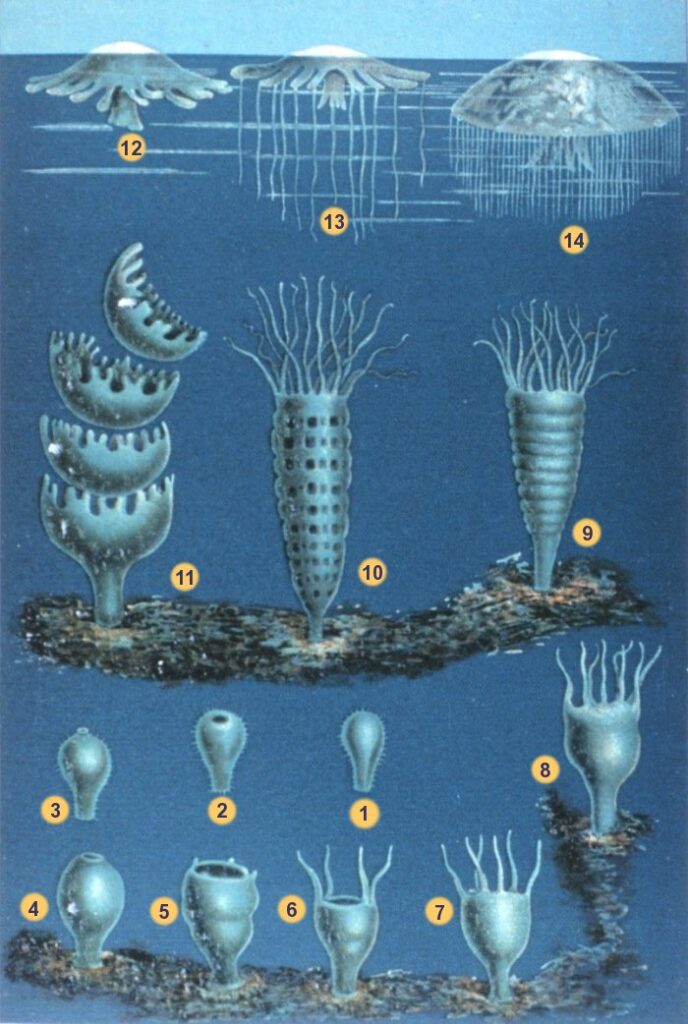
Jelly lifecycle. First, larva are born and raised in the jellyfish underbelly or oral arms. Then, in 1-3 the larva searches for a site. 4-8, the polyp grows. 9-11, the polyp begins to shed baby jellies. 12-14, the medusa grows in order to make new larva. (Note, modern research by Jessica Schaub shows the original polyp has obvious tentacles used for gathering food. From Wikipedia, by Matthias Jacob Schleiden (1804-1881) – Schleiden M. J. “Die Entwicklung der Meduse”. In: “Das Meer”. Verlag und Druck A. Sacco Nachf., Berlin, 1869.NOAA photo librarySchleiden-meduse.jpg, Public Domain, https://commons.wikimedia.org/w/index.php?curid=816317

When the polyps get old enough, they start shedding new jellies, about 10 per year for moon jellies. That process is sort of like growing a flower which eventually wiggles off the main stem. The polyp is cloning itself.

The little clone is a baby jelly, about the size of a quarter (2.5 centimeters, or 1 inch in diameter) called an ephyra. The ephyra grows into a full size jellyfish in about 2 months, super fast. The adult is scientifically called a medusa, because of the bell-shaped body with tentacles.

Jessica considers the polyp to be the main animal. The medusa’s purpose is to mate and produce more larva. The medusa usually dies shortly after producing babies, but the polyp lives on for years, creating new clones.

Jessica describes in her video the amazing process of how the polyp can also clone itself two other ways. The polyp can create a whole new polyp. Also, it can deposit a podocyst which is a seed like critter that can attach to a surface to grow into a new polyp. Podocysts can hibernate if growing conditions are not favorable. As if that’s not enough, the polyp itself moves around. As it “walks” along the thing it’s living on it deposits a podocyst, and those are often found in a line that tracks the polyp’s movement.

Polyps can attach to rocks, but also plastic, wood, common dock building materials. Human activity thus creates more living environments for jellyfish communities.

So if I understand this right, a polyp reproduces three ways. It can make little podocyst’s which can make a new polyp, it can make a whole new polyp, and when it sheds an ephyra it’s basically making a clone of itself whose primary job is to eat, grow, sexually reproduce new babies from sperm and eggs, and then die. Wow.

Jessica’s YouTube video on her research is at https://www.youtube.com/watch?v=vAvTd4Lf1Ik.

Jellyfish and climate change

Jelly smacks are common in the summer, and may be increasing in Puget sound. There is enough concern that the Washington State Department of Ecology conducted a study published in 2016. They are increasing in some parts of the world, sometimes with severe economic and environmental impact.

The Nature of Things documentary on jellyfish by David Suzuki provides a nice overview of their complex nature and harm to world fisheries.

Jellyfish appear to be capable of quickly and massively colonizing regions that are damaged from overfishing or suffering environments detrimental for fish. Fish and jellies compete for resources. In places where jellies have taken over it is hard for fisheries to re-establish themselves.

Preventing jellyfish from overtaking a distressed ecosystem has proven hard to accomplish, so keeping fishery environments healthy is important.

World Jellyfish Day

November 3rd is World Jellyfish Day. Thus, the November 15 2024 Port Angeles smack missed celebrating in Port Angeles by 12 days. If they travel about a mile a day, maybe they celebrated at Salt Creek?

A quick technical note

When I use the word jellyfish and describe a unique feature of the animal I am specifically referencing true jellies which are in the scientific class Scyphozoa. Not everything that applies to jellyfish described above applies to other cnidarians like anemones and hydrozoas. For example, crystal jellies are not true jellyfish, they are in the hydrozoan class and as such don’t have oral arms. Like everything else in the cosmos, there’s always exceptions even for the true jellies and I haven’t gotten into that level of detail here.

Video resources for more information about jellyfish

How does a jellyfish sting? A TED-Ed talk, 4:17 minutes
Jellyfish predate dinosaurs. How have they survived so long? A TED-Ed talk, 5:26 minutes
The one thing stopping jellyfish from taking over. A TED-Ed talk, 5:35 minutes
15 incredible jellyfish species. 18:31 minutes
Vicious beauties – The secret world of jellyfish. Nature, 44:04 minutes
Jellyfish rule. The Nature of Things, David Suzuki, 44:44 minutes

Reading resources

Wikipedia, Jellyfish, overview article
Wikipedia, Cnidaria (pronounced ny-dar-eea), article describing the related group of jellies, corals, anemones and hydrazoids
Wikipedia, Cnidocyte, article describing the stinging cell
Colin, Sean P., John H. Costello, and Eric Klos. “In situ swimming and feeding behavior of eight co-occurring hydromedusae.” Marine Ecology Progress Series 253 (2003): 305-309.
Berwald, Juli. Spineless: the science of jellyfish and the art of growing a backbone. Penguin, 2017.
Gershwin, Lisa-Ann. Stung!: On jellyfish blooms and the future of the ocean. University of Chicago Press, 2013.


I hope you enjoyed this story of another set of amazing and elusive creatures on the Olympic Peninsula and it’s waters. If you have some pictures of the Port Angeles smack and want to share them in this article, contact us at the link above.

I thank the guys down at the Port Angeles Boat Haven Harbormasters office, the couple from New Zealand (via Canada) who shared the joy on the boat launch dock, and photographer and writer (and Port Angeles Farmer’s Market vendor) Nirvan Hope who first spotted the smack at sunrise on Ediz Hook.

I give a special thanks to Tamara Galvan of the Feiro Marine Life Center in Port Angeles for scientific feedback on the article, species identification and reading materials. And also to Jessica Schaub for feedback and clarification on the jellyfish life cycle, for help with species identification and reading materials. Jessica is a PhD Candidate in Oceanography, Pelagic Ecosystems Laboratory, Institute for the Oceans and Fisheries (IOF), University of British Columbia. Her work is excellent and I wish her all the best in a long career in oceanography.

I spoke to one local sport fisherman who said he caught an unusual amount of jellyfish in his lines last year, 2023. If you have any similar experience, noticing either an increase or decrease, please let us know, or contact the Feiro Marine Life Center.

This article is part of a ClallamCountyBar.com series for families and children on nature on the Olympic Peninsula. Please consider contributing to the series.

Mark Baumann

Filed Under: Bar News, Local feature articles, Nature on the Olympic Peninsula, Parenting, SNACCMS

Peace Discipline – one minute videos

November 25, 2023

Peace Discipline is a parenting website offering a rich source of free and state-of-the-art parenting tools, tips, video how-to’s, and the results of their 5-year research study. Peace Discipline is owned by Karen Quail. She offers parenting classes, some are general and some are specific, such as for parents of children with ADHD or ASD. You can watch their videos on their YouTube channel, or sign up for their email newsletter and get their very cool 1-minute videos delivered right to you every week.

Karen Quail is also available for private parent-coaching.

Click here to go the Peace Discipline sign email sign-up page: https://www.peacediscipline.com/#footer

Filed Under: Bar News, Family Law, Parenting

Hurricane Ridge is closed due to rare cougar attack

July 30, 2023

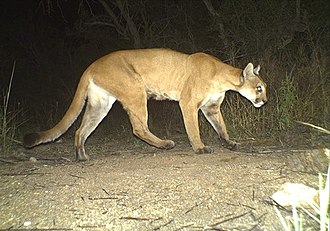
Sunday, July 30 2023. Hurricane Ridge and parts of Olympic National Park are closed due to a rare cougar attack on an 8 year old boy at Lake Angeles on Saturday night July 29 2023. ONP is closed in an area approximately 10 miles in diameter around Lake Angeles. On the Hurricane Ridge Road, the closure starts at the Hurricane Ridge Road park entrance station, which necessarily closes access to the Hurricane Ridge parking lot.

Closed trails include the Lake Angeles and Heather Park trails (top-to-bottom from the entrance station area), and in the high country the Switchback and Klahane Ridge trails,.

The Hurricane Ridge Road entrance station is five miles up the mountain from the ONP visitor center, and about 7 miles from Highway 101 and Race street in Port Angeles. It is not known at this time if the Heart of the Hills campground is closed.

According to an ONP press release, the boy and his family were camping at Lake Angeles, which is 3.5 miles up the trail from the trailhead near the entrance station. The cougar casually abandoned its attack after the boy’s mother yelled and screamed at the cat. Park Rangers were immediately dispatched and stabilized the boys condition, and then provided safe escort back to the trailhead. The boy suffered minor physical injuries which treated at a local hospital.

At 5:00 a.m. Sunday morning, ONP law enforcement and wildlife personnel specializing in cougar tracking, with dogs, were dispatched to locate the cougar. If found, the cougar will be euthenized and a necropsy performed to see if the cause of the attack can be determined.

Cougar attacks, especially in Olympic National Park are extremely rare. It’s even rare to see a cougar in the park. The last attack documented in local news reports was approximately 33 years ago. In recent years there have been cougar attacks on Vancouver Island and in foothills east of Seattle. Those attacks are usually by adolescent cougars. A person in Oregon was dragged off their bike and killed by a cougar in mountains in Oregon.

No bear attacks on humans have ever been reported in Olympic National Park, according to local news sources. ONP only has black bears. Brown bears and grizzly bears attack people every year, however, neither of these types of bears exist in ONP. In other parts of the United States and Canada, there have been a few reports of black bear attacks. A food-conditioned black bear on Vancouver Island, Canada, attacked an elderly sheep and ripped into four tents (which presumably had food in them) two days ago. On June 17 2023, a black bear in Arizona attacked and killed Steven Jackson, a 66 year old man. He was camping at his rural property while he was building a home.

Bear spray may be effective to prevent cougar attacks, as seen in several videos on YouTube. Cougars are normally extremely reclusive animals and tend to avoid humans. However, cougar scat is regularly seen throughout the Hurricane Ridge area, including on dirt and paved trails.

Cougars are the only North American lion. They are also known as mountain lions, pumas, and panthers such as the Florida black panther.

Approximately 33 years ago, a teenager was attacked by a cougar in Olympic National Park. He was riding his bike down the old hurricane ridge road, now known as the Wolf Creek trail which ends at the Whiskey Bend trailhead. He was was taking a break when he was attacked. The teenager happened to be a wrestler on the Port Angeles High School team, and he wrestled the cougar, eventually putting the cat into a full Nelson hold. A full Nelson involves the wrestler getting behind the opponents body and wrapping both arms under the armpits (front “arms” in this case) and interlocking the fingers on the opponents neck. This move immobilized wrestling opponents, and it worked on the cat. Once immobilized, the teenage wrestler and the cat sat for a few moments in stillness, listening to each other’s breath. When the wrestler finally let go, the cat took off running and the wrestler continued home safely with only minor injuries. (If you were that teenager, please contact ClallamCountyBar.) This story was published in the Peninsula Daily News paper (long before the internet was a thing).

ClallamCountyBar.com wishes the boy and his mother a full recovery from the trauma of this experience.

This article will be updated as new information is available. At the time of publication, ONP has released a press release but has not posted any news announcements but presumably will at their news page.

Filed Under: Local feature articles, Nature on the Olympic Peninsula, Parenting, SNACCMS

Clallam Resilience Project: Ecotherapy and vocalization techniques for grounding

May 9, 2023

June 6, 10:00-11:30 a.m. This session of the Clallam Resilience Project will feature two presenters, Mindy Gelder and Noah Smith, both addressing somatic approaches to resilience building.

http://us02web.zoom.us/j/89928194489?pwd=Nmx4NkZ2eVpZbldNYk9tY2k4YUJNZz09

Ecotherapy techniques for grounding and emotion regulation

Mindy Gelder, PhD has been working as a licensed marital and family therapist for the past 23 years. About ten years ago, she grew tired of more traditional means of counseling and of sitting in a chair all day. Her own passion for the natural world led her to pursue a certification in Ecotherapy, and today, she can be found taking clients on beach walks, hosting Ecotherapy workshops, and engaged in somatic approaches to help others heal and connect with the natural world and their own authentic human selves.

Join us as she shares a little about Ecotherapy and provide some specific exercises to help folks connect with nature and its healing elements.

Self, Community and Singing

Featuring presenter Noah Smith (they/them), Director, Peninsula Queer Xhoir, Director of Music Ministries, Holy Trinity Lutheran Church, Dean, American Guild of Organists Olympic Peninsula Chapter.

The act of singing and musical vocalization offers many interpersonal and intrapersonal benefits, working against trauma and isolation. In this presentation, Noah Smith will explore how singing can be utilized in many settings as an activity that may unlock possibilities and solutions.

Clallam Resilience Project

You are invited to the monthly Clallam Resilience Project Community Meeting every first Tuesday at 10am until 11:30.

View the Clallam Resilience Project Community Meeting webpage for upcoming meeting information and past meeting minutes/resources/more.  

Join Zoom Meeting https://us02web.zoom.us/j/89928194489?pwd=Nmx4NkZ2eVpZbldNYk9tY2k4YUJNZz09 Meeting ID: 899 2819 4489  Passcode: HOPE

Questions? Contact [email protected].

The Clallam Resilience Project is a United Way of Clallam County program.

Filed Under: Mental health, Parenting, Parenting Education

Clallam Resilience Project: Resilience in the face of love and grief

February 27, 2023

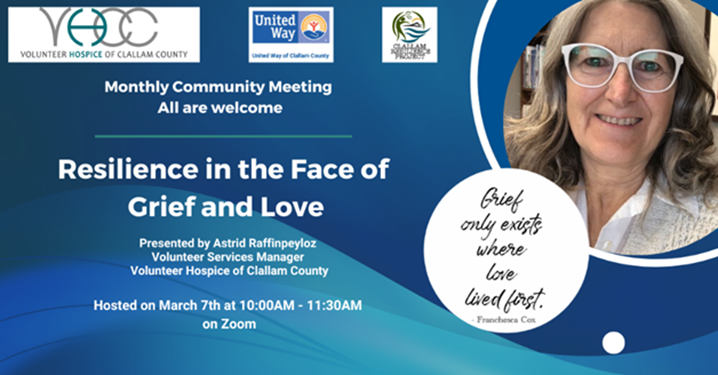
The Clallam Resilience Project will host a Zoom meeting on Resilience in the Face of Grief and Love, presented by Astrid Raffinpeyloz, Volunteer Services Manager at Volunteer Hospice of Clallam County.

The meeting is Tuesday, March 7th 10-11:30, on Zoom.

Image notice for Clallam Resilience Project community meeting on Resilience in the face of grief and love

How does the staff at Volunteer Hospice provide care and support despite witnessing and accompanying others with frequent losses? We don’t have all the answers, but we hope that you can come away from this presentation with a few more tips and tools in your bag. Come gain a deeper understanding of how grief and love are intertwined.

You are invited to the monthly Clallam Resilience Project Community Meeting every first Tuesday at 10am until 11:30.

View the Clallam Resilience Project Community Meeting webpage for upcoming meeting information and past meeting minutes/resources/more.  

Join Zoom Meeting https://us02web.zoom.us/j/89928194489?pwd=Nmx4NkZ2eVpZbldNYk9tY2k4YUJNZz09 Meeting ID: 899 2819 4489  Passcode: HOPE

Questions? Contact [email protected].

The Clallam Resilience Project is a United Way of Clallam County program.

Filed Under: Family Law, Parenting, Parenting Education

Low Bono mediation 2023: Family Law Project

February 19, 2023

Port Angeles Pro Bono and Angeles Mediation are offering low bono family law mediations in 2023, for residents in Clallam and Jefferson counties. Low bono means low cost services by a lawyer working as a mediator. For more information see the Port Angeles Pro Bono page.

Filed Under: Domestic Violence, Family Law, Low Bono, Mediation, Parenting, Pro Bono Events

Peace Discipline programs winter 2023

January 20, 2023

Peace Discipline offers a fabulous and rich set of parenting and discipline guidelines designed to help children maximize their neural development and psychological health. It’s the perfect antidote for the stress of todays world. They have four upcoming programs. These are on Zoom and are small group sessions at a cost of $20 each, and taught by PD creator Karen Quail. Karen is a school counselor and parenting skills researcher and author.

Boundaries with Adolescents Thurs 26th January 2023

Peace Discipline Applied: ADHD in the Classroom Thurs 2nd February 2023. This is a workshop and people joining are welcome to ask questions and share their experiences.

High Sensitivity and Autism in Families and Schools Thursdays 9th and 16th Feb 2023

Temperament Wednesdays 22nd Feb; 1st, 8th & 15th March 2023

Click here for details and registration information. Karen Quail is located in South Africa, and since the programs begin at 7:00 pm South African time, they happen at 9:00 am Port Angeles / Seattle time. It’s a special opportunity see how parents face the same struggles everywhere in the world, and to hear Karen Quail’s simple, easy, and effective techniques. Plus, you get a tiny and virtually-warm vacation where it is summer-time in South Africa.

You can see all of Karen’s free videos on the Peace Discipline YouTube channel.

Filed Under: Family Law, Parenting, Parenting Education

Clallam Resilience Project: Immigrant families – experiences from adversity to resilience

January 16, 2023

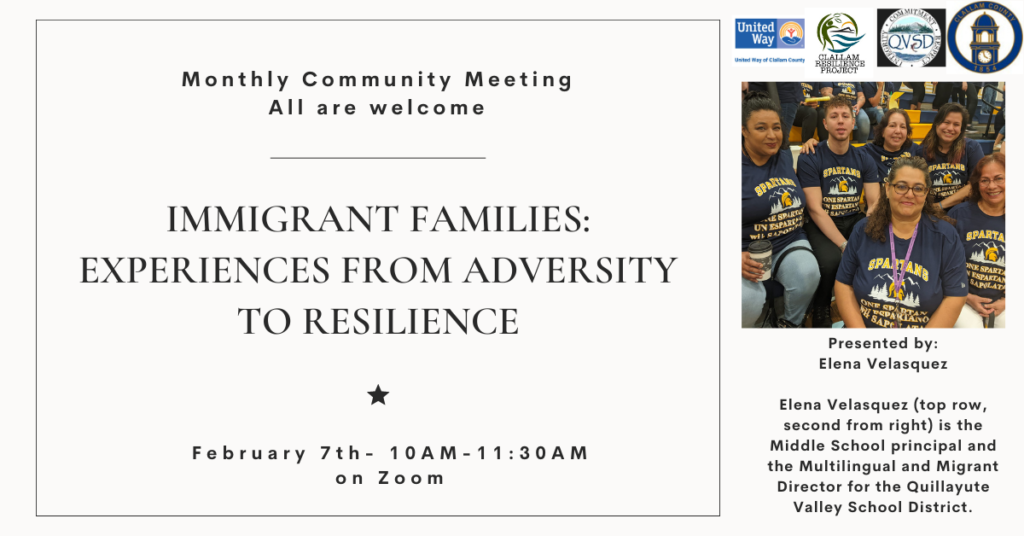
The Clallam Resilience Project will host a Zoom meeting on the adversity and trauma faced by many immigrant families. The session is on Tuesday February 7th, 2023, from 10:00 – 11:30am.

Clallam Resilience Project: graphic notice, topic is Experiences from adversity to resilience

Participants will learn about adversity and trauma faced by many immigrant families, how families acculturate to living in the United States and ways to foster resilience as families navigate acculturation in their new communities.

Elena Velasquez grew up in Forks since 1979 when her family immigrated from Mexico and for the past 6 years has been the Middle School principal and the Multilingual and Migrant Director for the Quillayute Valley School District, will present.

Zoom Meeting ID: 899 2819 4489
Passcode: HOPE

Questions? Contact: [email protected]

The CRP is a United Way of Clallam County program.

Filed Under: Family Law, Parenting

Clallam Resilience Project: NOHN, the Olympic Peninsula’s community health center: a vision for resilience

December 23, 2022

Why are community health clinics a model for resilience? 

Is it the ability for “upstream” engagement? 

Or addressing the social determinants of health? 

Come learn about North Olympic Health Network (NOHN) from Carlos Osorio, Community Outreach and Navigation Department Manager.  He will speak to how NOHN serves our community by connecting residents with resources, like the mobile clinic, that help them get and stay healthy. 

Meeting details

January 3, 2023, from 10:00 a.m. to 11:00 a.m.

Hosted by Carlos Osorio, North Olympic Health Network

Join Zoom Meeting

  • Meeting ID: 899 2819 4489  Passcode: HOPE  
  • Dial in by phone: +1 253 215 8782     Phone Passcode: 706561

Hosted by the the Clallam Resilience Project, a United Way of Clallam County project.

For more information, contact Sydney Crowe, program manager for the Clallam Resilience Project, [email protected].

Filed Under: Bar News, Family Law, Local resources, Parenting, Parenting Education

  • Page 1
  • Page 2
  • Page 3
  • Interim pages omitted …
  • Page 6
  • Go to Next Page »

Primary Sidebar

Courtroom Zoom information

Find a Lawyer

Local feature articles

USX-1 Defiant conducting sea trials in Port Angeles Harbor, passing by the Harbor Pilot ship dock.

USX-1 Defiant: sea trials in Port Angeles Harbor

August 28, 2025

8/28/2025 The brand new and experimental naval ship USX-1 Defiant is conducting sea trials in Port Angeles Harbor and the Strait of Juan de Fuca. The Defiant is a drone ship, … [Read More...] about USX-1 Defiant: sea trials in Port Angeles Harbor

Two varieties of Olympic Mountain blueberries, intertwined in what appears to be one bush

How many species of wild blueberries in Olympic National Park?

August 25, 2025

6, 8, 9, or 12 (?) kinds of wild blueberries in the Olympics? There are quite a few species of blueberries in the Olympic Mountains. A number of plant identification books … [Read More...] about How many species of wild blueberries in Olympic National Park?

More local feature articles

Legal Resources

  • Angeles Mediation
  • Avvo Legal Directory
  • Clallam Superior Court
  • Gov: City of Port Angeles
  • Gov: Clallam County
  • Gov: Superior Court Clerk
  • Law: Court forms
  • Law: RCW- WA statutes
  • Northwest Justice Project
  • Washington Law Help (free)
  • Washington State Bar Association

Categories

DV Blog

Courthouse Facilitator position vacant until March 1 2026

Hope Card: easy carry protection order information

Low Bono mediation 2023: Family Law Project

More DV information

Pro Bono

Free legal advice on Saturday July 18, 2026

May 17, 2026

On Saturday, July 18, 2026, the Clallam-Jefferson County Pro Bono Lawyers will provide a free legal … [Read More...] about Free legal advice on Saturday July 18, 2026

Free legal advice May 16 2026

May 7, 2026

Free one-on-one legal consultations with a lawyer are available on Saturday, May 16, 2026. These … [Read More...] about Free legal advice May 16 2026

Free legal advice for tenant rights, April 25 2026

April 16, 2026

A live presentation on tenant rights and evictions, and free one-on-one legal consultations with a … [Read More...] about Free legal advice for tenant rights, April 25 2026

Courthouse Facilitator

December 1, 2019

The Courthouse Facilitator helps people find and fill out family law forms. They are not lawyers and … [Read More...] about Courthouse Facilitator

Free legal advice Saturday February 21, 2026

January 14, 2026

On Saturday, February 21 , 2026, the Clallam-Jefferson County Pro Bono Lawyers will provide a free … [Read More...] about Free legal advice Saturday February 21, 2026

Free legal advice on Saturday May 16, 2026

February 22, 2026

On Saturday, May 16, 2026, the Clallam-Jefferson County Pro Bono Lawyers will provide a free legal … [Read More...] about Free legal advice on Saturday May 16, 2026

More pro bono news

Family Law News

Brian Parker terminated from position of Clallam County Family Court Commissioner – effective immediately

February 11, 2026

Brian Parker, Clallam County Superior Court Family Court Commissioner, was abruptly terminated from his position on February 10, 2026. The Superior Court announced his appointment to the position in … [Read More...] about Brian Parker terminated from position of Clallam County Family Court Commissioner – effective immediately

Old Clallam County Courthouse

Courthouse Facilitator position vacant until March 1 2026

January 27, 2026

The Clallam County Courthouse Facilitator position is currently vacant. A new Facilitator will begin offering help with filling out court forms on March 1, 2026. Temporary help In the meantime, … [Read More...] about Courthouse Facilitator position vacant until March 1 2026

A view of the old and new Clallam County courthouses from 4th street, in Port Angeles

Maria Malkasian is the new Courthouse Facilitator

May 15, 2025

The Clallam County Court Facilitator is Maria Malkasian. Her office is now in room 3003 at the courthouse, across the hall from Courtroom 3, the Family Court, 223 East 4th Street, Port Angeles, WA … [Read More...] about Maria Malkasian is the new Courthouse Facilitator

Logo for the Washington chapter of the Association of Family and Conciliation Courts, an image of Washington state in green with the AFCC international logo

CLE: Managing parent child contact problems WA AFCC

February 18, 2025

Parent child contact problems (PCCP) is one of the most difficult challenges in family law cases. The Washington Chapter of the Association of Family and Conciliation Courts (AFCC) is holding it's … [Read More...] about CLE: Managing parent child contact problems WA AFCC

More family law news

A sustainable site

CCB.com is a 1-tree sustainable website. https://www.websitecarbon.com/

Copyright © 2026 Mark Baumann