8/28/2025
The brand new and experimental naval ship USX-1 Defiant is conducting sea trials in Port Angeles Harbor and the Strait of Juan de Fuca. The Defiant is a drone ship, the first ever designed to never operate with any human crew on board.
It is 180 feet long and is exceptionally narrow, shaped overall like a canoe. It sits very low in the water, its deck appears to be no more than 10 feet above the water line. It’s tower tops out at 42 feet tall. It has a top speed of 20 knots (23 MPH).
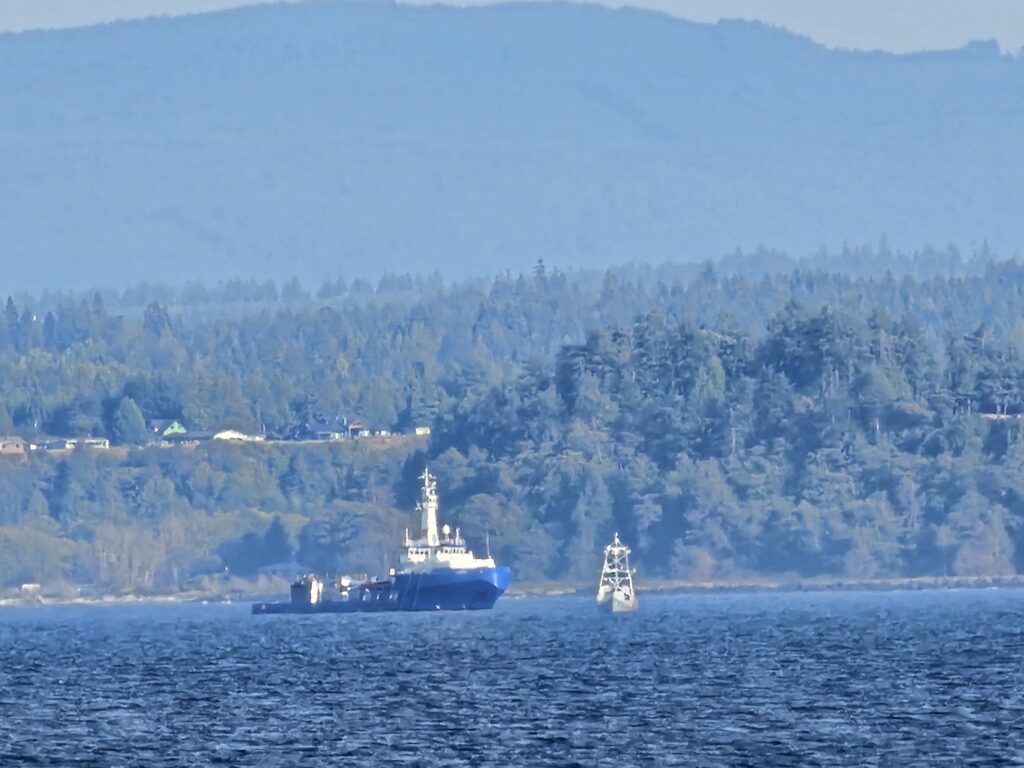
It can serve in roles of surveillance, logistics, attack and defense, carrying a 132,000 lbs load. That’s the equivalent of 24 Chevrolet Tahoe SUVs, or about 264 adult black bears and a load of Olympic blueberries to feed them.
Defiant can stay on a continuous sea patrol for one year. It uses marine diesel fuel. Long sea voyages require fueling at sea (FAS), which is problematic when there are no humans on board to safely receive and insert fueling hoses. This problem was addressed with specially designed FAS systems which require no humans on board the Defiant. A successful FAS trial was completed in December 2024.
Its sturdy and can conduct its mission in sea state 5 weather and higher, which are rough and windy seas with waves up to 13 feet. It can survive in sea state 7 weather, which has high seas and waives up to 30 feet. (Sea state 6 waves can go up to 20 feet, sea state 8 up to 46 feet and considered very high seas, and sea state 9 waves are anything over 46 feet high and phenomenal seas.)
Defiant was christened and launched on August 11, 2025, at the Everett Ship Repair in Everett, Washington. Serco is the prime contractor responsible to build the Defiant. It was built at Nichols Brothers Boat Builders in Washington State.
According to a DARPA spokesperson, Defiant was named after the USS Defiant, a starship in the Star Trek series Deep Space Nine. USS Defiant was small but might warship.
Escorted by Melissa C
For the current sea trial, Defiant is being escorted by the workboat Melissa C. Here they are at rest on August 25, 2025, after a long day of work, preparing to dock for the night in Port Angeles.
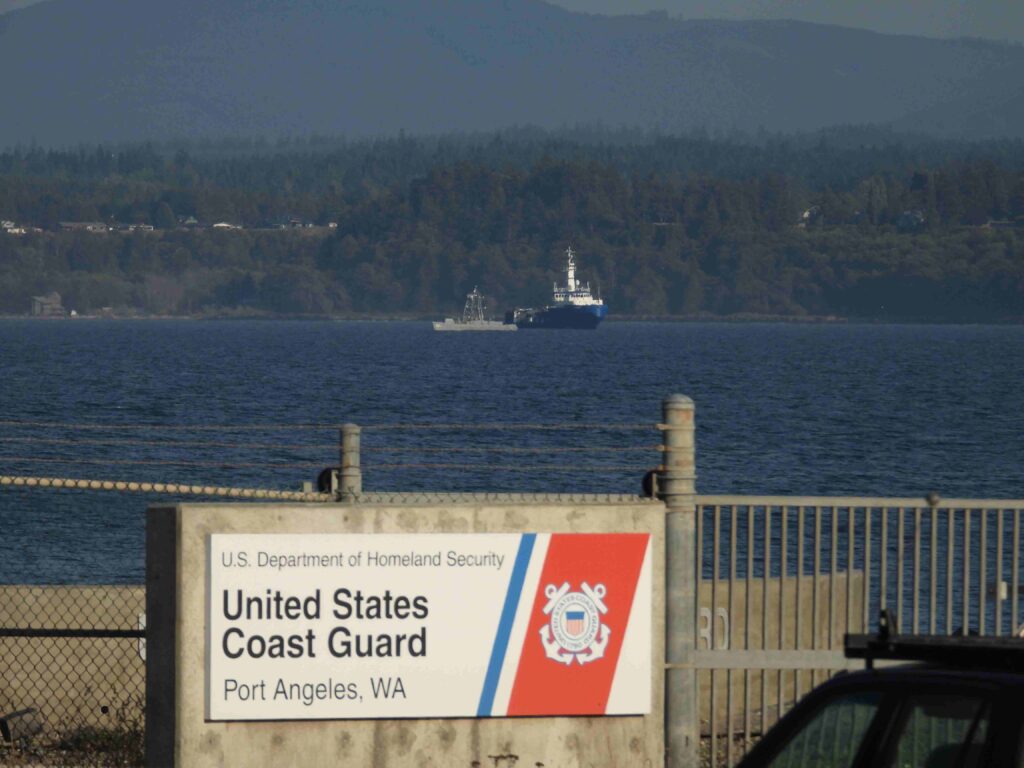
In the morning, tethered together, Melissa C escorted Defiant out of dock.
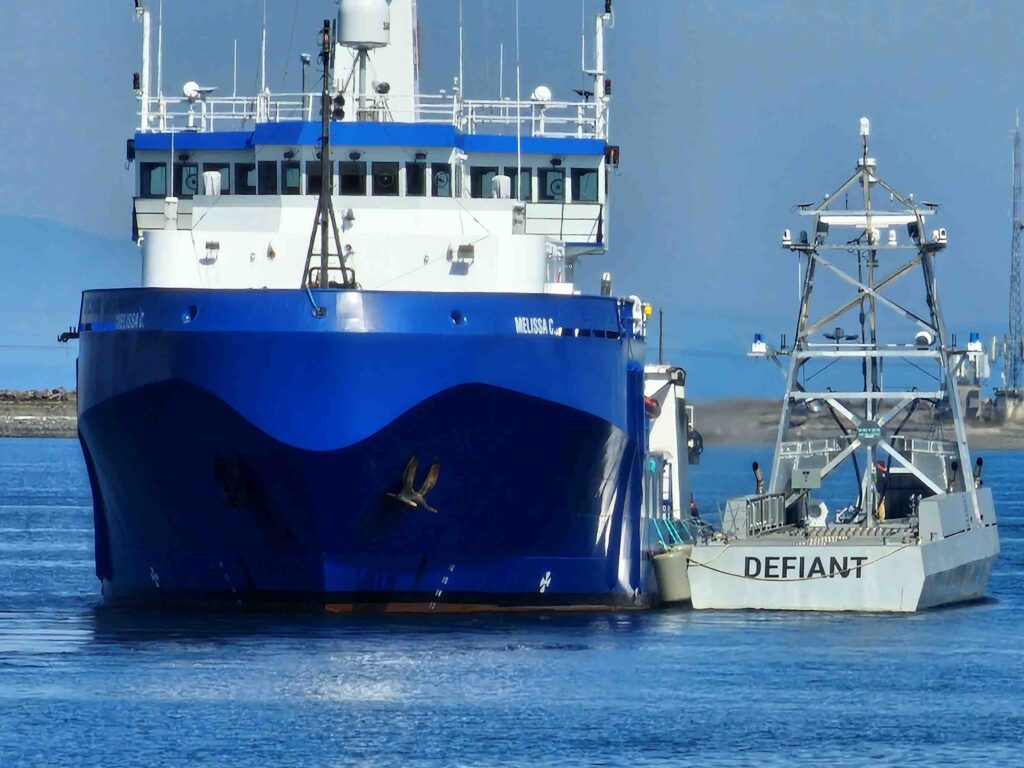
A crewman on the Melissa C is seen on Defiant’s deck before the tether is withdrawn and Defiant is set free. The white structure on the left is part of the crane boom on Melissa C. Ediz Hook is in the immediate background, and the hills of Vancouver Island, BC, in the distant background.
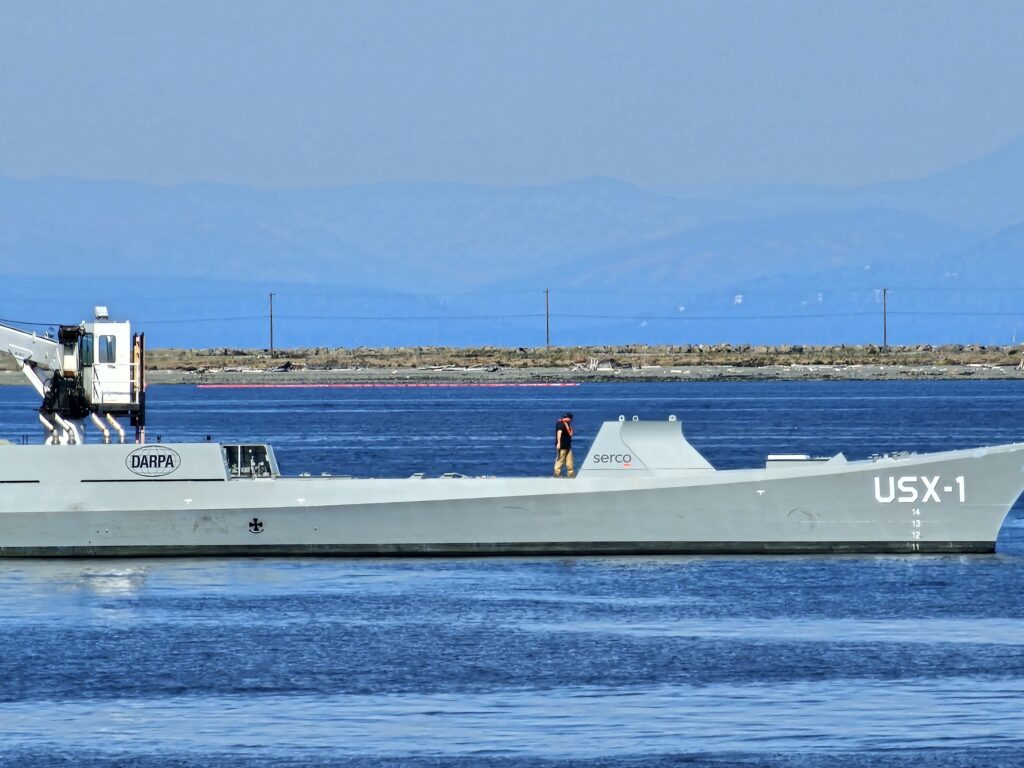
Here, Defiant and Melissa C are engaged in sea trials in the Strait of Juan de Fuca. The hills on Vancouver Island, BC, are in the background.
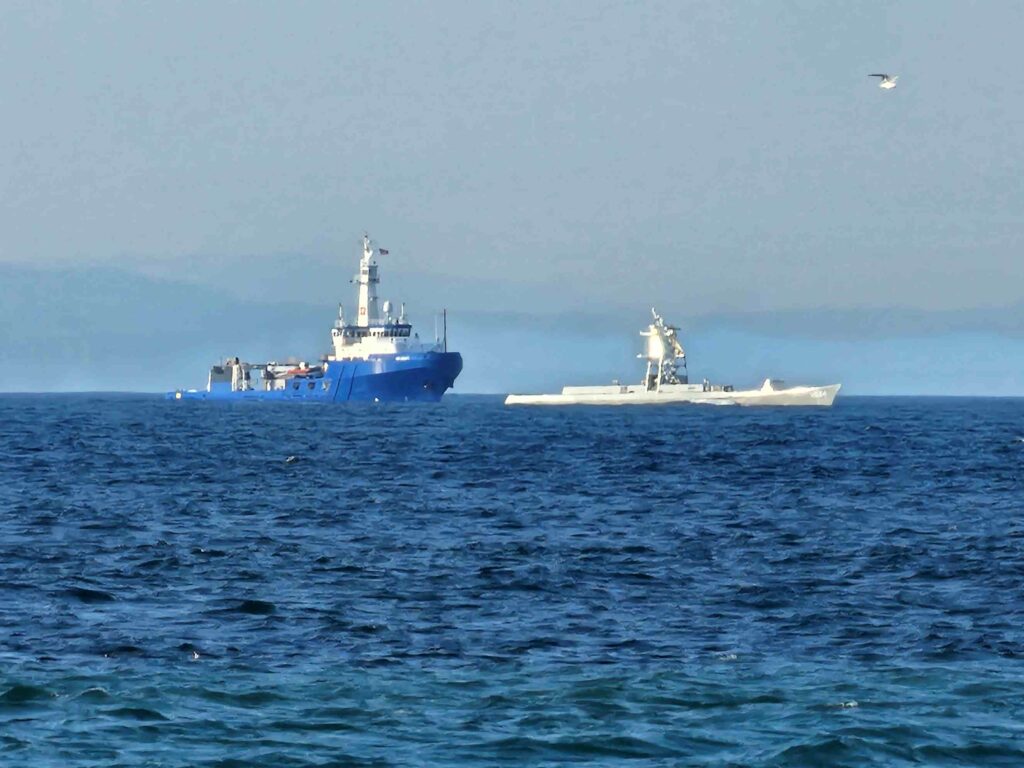
If you want to follow Defiant and Melissa C, you can find them on MarineTraffic.com.
DARPA and experimental projects
The Defiant is not yet a Navy ship. As indicated by its call sign USX (rather than USN), it is an experimental craft. It’s truly experimental. At this point, it’s not known if it can carry out its mission. Defiant has just started the process of a one year true sea trial. It’s taking baby steps in Port Angeles Harbor.
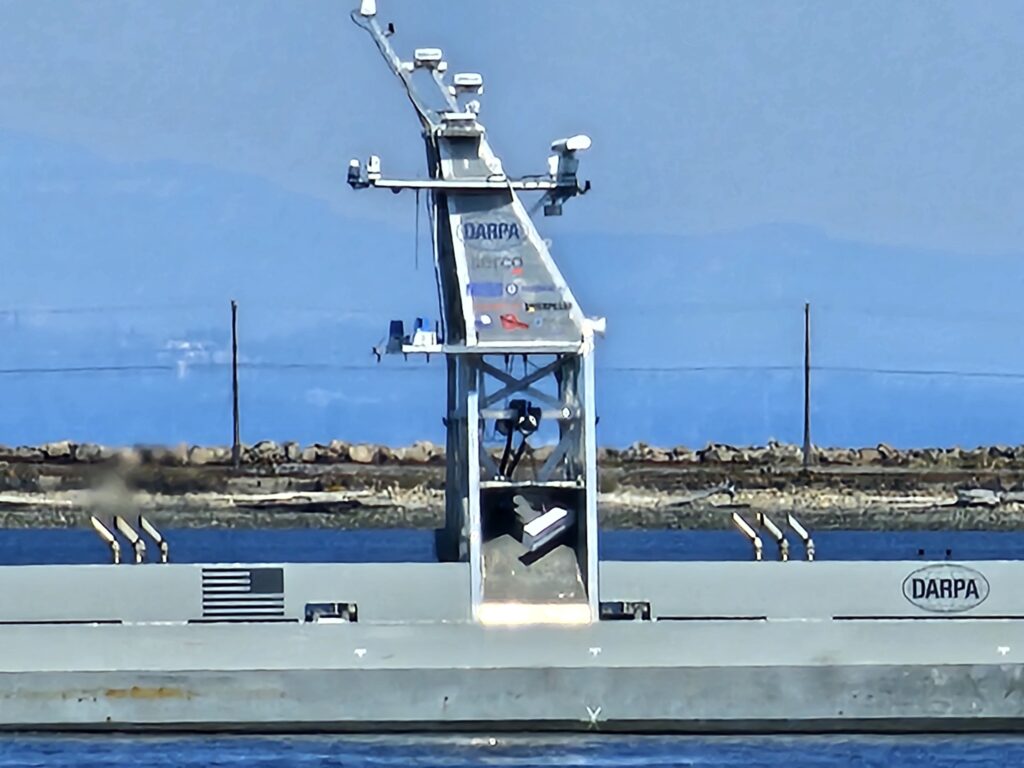
The Defiant project was developed by the Defense Advanced Research Projects Agency (DARPA), which is a research and development agency of the United States Department of Defense responsible for the development of emerging technologies for use by the military.
It’s part of the No Manning Required Ship (NOMARS) program. One goal of NOMARS is to increase American naval capacity at a much reduced cost. In 2025, the US Congress established a $2.1 billion budget for development and building of drone ships.
DARPA has developed many projects for the military, such as Vertical Take Off and Landing used in Boeing Osprey planes and next generation night vision goggles. They have also developed many projects that led to advances for regular citizens. DARPA developed ARPANET which was the first version of the internet, and the Aspen Movie Map which was the first version of products like Google Street View.
Unique design features
The Defiant is a unique ship because it’s the first fully autonomous vessel designed to never accommodate humans on board. DARPA and the Navy have already experimented with hybrid ships which can be operated as a drone or with humans on board. Those ships required all the facilities humans need including passageways everything needed for living quarters. Human needs take up a lot of space on a ship.
There are no passageways, sleep, cooking or other facilities for humans on board the Defiant. This allows the ship have its narrow design, low hull, and Long length. Narrow design allow ships to travel through water faster and with less energy needs, and to allow it to have a minimal wake.
The Defiant sits low in the water with a very low profile. Presumably this helps it minimize its exposure to radar and increase its stealth abilities.
It also has a simplified hull structure and ship design, so that new ships can be inexpensively built and maintained at any Tier III shipyards, which build smaller and specialized ships. Defiant class ships can be built at a Navy or private Tier III shipyard. Thus, any shipyard facility which can build a yacht, tug or workboat can build and service Defiant class ships. The Nichols Brother’s Boat Builder’s Washington facility is an example of a private company building a relatively low cost ship for our military.
Strait of Juan de Fuca and the Port Angeles Harbor
The City of Port Angeles is in Washington State, in the top middle of the Olympic Peninsula. It is next to the northern boundary of Olympic National Park and sits on the Strait of Juan de Fuca. Black Ball Transportation operates the M.V. Coho car ferry between Port Angeles and Victoria, British Columbia, Canada. Port Angeles is about 80 miles (by the ferry route) north and west of Seattle.
Here is Defiant and M.V. Coho, with Vancouver Island, BC, in the background.
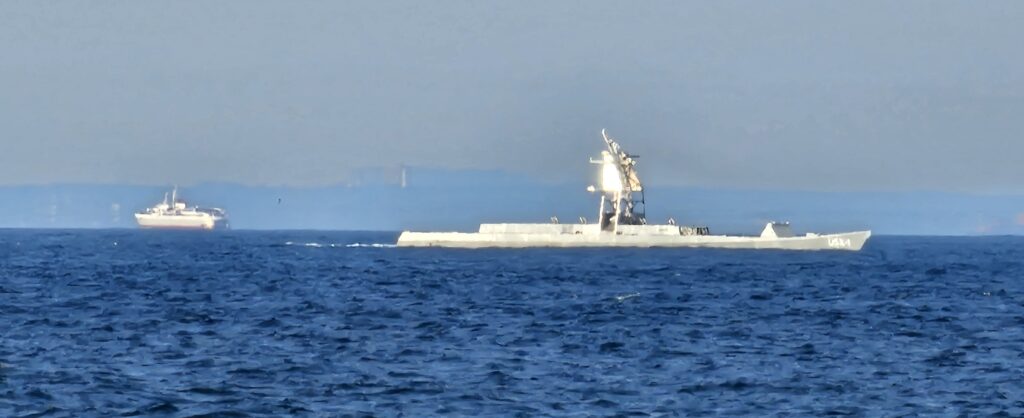
The Strait of Juan de Fuca is primarily bordered by the southern end of Vancouver and the north end of the Olympic Peninsula. It’s about 96 miles long, about 12-25 miles wide, and is part of the Salish Sea, and was filled with glaciers up to a mile thick in the last Ice Age. The Salish Sea is all the inland water in the picture below. It extends up into British Columbia and down into Washington State.
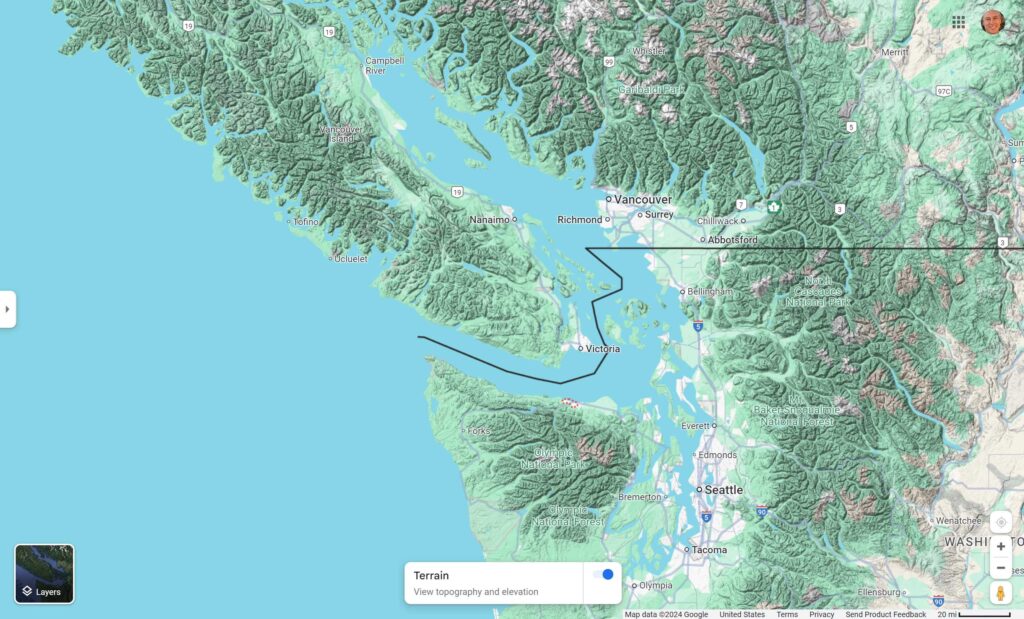
Port Angeles Harbor is home to the Lower Elwha Tribe of the S’Klallam Coast Salish people. In 1791 Spanish explorer Francisco de Eliza entered the harbor and named it Puerto de Nuestra Señora de los Ángeles (Port of Our Lady of the Angels). It’s considered the best deep water harbor in all of the Pacific coast Americas, including North, Middle and South America. It’s protected by a naturally formed sand spit called Ediz Hook.
Source references for this article
A special thanks to DARPA public affairs for their help with this article.
https://www.darpa.mil/news/features/nomars
https://en.wikipedia.org/wiki/DARPA#Past_or_transitioned_projects
https://en.wikipedia.org/wiki/Salish_Sea
https://en.wikipedia.org/wiki/Sea_state
https://en.wikipedia.org/wiki/Salish_Sea
https://en.wikipedia.org/wiki/Strait_of_Juan_de_Fuca
https://en.wikipedia.org/wiki/Port_Angeles,_Washington
https://en.wikipedia.org/wiki/Klallam_people
https://en.wikipedia.org/wiki/Lower_Elwha_Klallam_Tribe
By Mark Baumann
This article is a ClallamCountyBar.com local feature article.
Law is an important service to the health of our community. Parenting is even more important.