• Skip to primary navigation
  • Skip to main content
  • Skip to primary sidebar
  • Zoom
  • Courts
  • Docket search (Odyssey)
  • Weekly calendars
  • WA court forms
  • Local feature articles

Clallam County Bar

Clallam County lawyers & legal news

Angeles Mediation

Avoid Court. Reduce costs. Quick results.

The alternative to going to court

Angeles Mediation

  • Home
  • Find a Lawyer
    • All Clallam Co. Lawyers
    • Accident/Personal Injury
    • Business, Corporation, Partnership
    • Criminal
    • Divorce & Family
    • Elder Law
    • Mediation
    • Other
    • Real Estate
    • Wills, Estate Planning, Probate
  • Bar News
    • Family Law
    • CLE
    • Pro Bono Events
    • DV Blog
  • Pro Bono
    • Pro Bono Events
    • Courthouse Facilitator
    • Domestic Violence Service Providers
    • Project Homeless Connect
    • Low Bono
  • Parenting
  • Services and Experts
  • Contact

Family Law

The forgotten heroes: Family and friends who call DV helplines

November 11, 2021

People who experience domestic violence are often hesitant to disclose their stories and reach out for help. Family and friends who have concerns or questions or who may be unsure about what is going on “behind closed doors” should call a domestic violence helpline. There are several agencies on the North Olympic Peninsula, all listed below. You can also call the National Domestic Violence Hotline at 800-799-7233

Seeing someone suffer from potential or actual domestic violence can be confusing, involve feelings of helplessness, isolation, and uncertainty about whether or not something should be done. It’s free to call a DV help agency and that is what they are for so they appreciate your calls. They can offer you information about all the many forms of domestic violence, which is also known by the phrases intimidation, bullying, coercive control, power and control, intimate partner violence, emotional or psychological abuse.

ClallamCountyBar.com recommends family and friends call sooner rather than later. Controlling behaviors tend to escalate so the sooner they are tended to the sooner everyone, including the children, can be safe and free to live life without fear.

Coercive control and DV are very common in America. Sometimes both people are involved but usually one person is the main driver and it can be by man or woman or by any gender. Research studies consistently find that over 33% of people experience some form of coercive control, so it’s common in society.

Possessive and controlling behaviors, and physical DV, often develop slowly, over time in a relationship, but can escalate quickly. DV doesn’t always involve physical control, which is why terms such as coercive control sometimes offer a better descriptive term.

Domestic violence comes in many forms, and usually involves a pattern of coercive behaviors, used by one person in a relationship to gain or maintain control over the other. It’s very common for control behavior to be done in a way that is hidden from family and friends, or is at least harder to see. Behaviors may include:

  • Isolating a person from family, friends and other social situations.
  • Limitations on freedom.
  • Stubborn refusal to compromise
  • Unrelenting threats, intimidation, and other forms of coercion to make others do what they want.
  • Switching between very charming behaviors and angry/aggressive behaviors.
  • Persistent blaming of others, and consistently avoiding true responsibility for one’s own actions.
  • Insisting other people solve problems.
  • Focus on self-needs, especially as an excuse to engage in controlling behaviors (they tend to want to satisfy their needs first, and other people’s needs take a back seat or get addressed “later.”
  • Minimizing behaviors used to control.
  • Denying they did anything at all.
  • Their stories and explanations are often “fuzzy” and difficult to follow. Their stories often make loose connections between things which when looked at a little more closely don’t actually make a lot of sense.
  • Put downs.
  • Threating to leave, make false reports to CPS or the police.
  • Doing illegal things to their partner.
  • Demanding their partner dismiss charges if they are filed.
  • Economic and financial control.
  • Emotional abuse.
  • Spiritual abuse.
  • Sexual abuse.
  • Stalking.
  • Weapon use or threats of use.
  • Physical abuse, including grabbing, pushing, spitting, kicking, throwing things, breaking things, and hitting. Harming animals and pets is an indicator of extreme and dangerous control. Choking (strangulation) is an indicator of very extreme domestic violence and increases the likelihood of death by 750%.

If your loved ones disclose concerns, seem to be oddly disappearing from social circles, show (or hide) bruises, feel overwhelmed by their relationships, it won’t hurt to call an agency and speak with an advocate about what you might seeing and feeling. For many reasons, it is often very hard for people who are in a DV situation to ask for help, but they need it. You may be able to help them get the help they need.

For professionals

The behaviors list above is based on traditional DV theory, and also on attachment theory as described by the Dynamic Maturational Model of Attachment and Adaptation (DMM). The DMM describes the attachment system as involving people’s use of self-protective strategies to survive danger. These strategies are usually developed in childhood, and the more extreme forms of strategies are developed in response to parents who lack skills to provide a nurturing and safe home environment. In adulthood, the strategies to survive a difficult childhood are often used in romantic relationships but are in many ways dysfunctional. When they don’t work, the person often just increases the intensity of the type of behavior. This is why DV tends to escalate. A more detailed list of typical “victim” and “aggressor” self-protective strategies from a DMM perspective is available here.

This article is based in part on a research article by Alison Gregory and colleagues.

Gregory, Alison, Anna Kathryn Taylor, Katherine Pitt, Gene Feder, and Emma Williamson. “‘.?.?. The Forgotten Heroes’: A Qualitative Study Exploring How Friends and Family Members of DV Survivors Use Domestic Violence Helplines.” Journal of Interpersonal Violence 36, no. 21–22 (November 2021): NP11479–505. https://doi.org/10.1177/0886260519888199.
Filed Under: Domestic Violence, Family Law

Positive discipline techniques – The Peace Discipline model is based on quality research

April 19, 2021

How do you discipline children without spanking or even yelling at them? The trick is to take a broad-based approach that incorporates several techniques. One of the problems to finding the right techniques has been that low quality research studies have led to suggestions which don’t work, or even backfire. Karen Quail, a teacher, school counselor, and researcher in South Africa dug into the problem and after figuring it out over a 5-year study, she developed a list of easy to implement techniques, and has made them available on her Peace Discipline website.

One example of a misunderstanding of parenting techniques is time-out and time-in. Highly respected researcher Dan Siegel promoted the idea of time-in (not isolating children because that can be a harsh rejection). Many people immediately assumed he meant that time-out was a bad idea. However, research shows that both methods are effective, if used in the right way, and at the right times.

South Africa has had a long history of harsh parenting, and Karen Quail was working on helping her country learn to take a new approach. As she was teaching, parents kept asking her, “Well, what do I do if I can’t hit them or yell at them?” She had some instinctual ideas, but she wanted to know what research recommended so she could give good advice. After she looked at lots of research studies and their recommendations, she realized that many of them contradicted each other, and often recommended techniques which seemed instinctively wrong to her. When she looked further, she realized many of the studies were not done properly and didn’t qualify as reliable science.

Massive research study on effective parenting discipline techniques

So to address the problem of poor science, she set out to do some good research science. She started by reading the abstracts (research summary) of over 35,000 research studies. (Yeah, that’s a lot.) From there, she tossed out studies that used ineffective research methods, and focused on meta-studies, which are research studies which look at many other studies. She eventually selected over 200 meta-studies to examine, and she compared all their findings, and organized what she was seeing. This took her five years! The result of her work is amazing. She was able to sort out a fairly small list of what she calls nonviolent parenting techniques which are all solidly supported by research. She calls the list a Peace Discipline Toolkit.

When she was done, she started to work on a book. But then she realized the purpose of her life’s work is to help parents, so she decided to make her Toolkit available for free on the internet. In addition, she offers free and quick YouTube videos. For parents who want a little more guidance, she offers online parenting classes at a very reasonable price. While South Africa is in a different Time zone, she offers them in the warm South African evenings so people in the U.S. can join them in the morning on the west coast and middle America, and around the lunch hour on the east coast.

Resources

You can find a summary of her research in the Child Discipline article on Wikipedia.

You can find her Toolkit on Peace Discipline.

Karen has a YouTube channel with a series of brief and pointed talks about how to implement Peace Discipline.

You can read her research study (advanced level reading), and a summary of her findings on each nonviolent discipline tool, which is freely available at Research (peacediscipline.com).

Peace Discipline techniques are consistent with the SNACCMS activities concept for helping children develop optimal neural growth, and with attachment informed parenting techniques.

ClallamCountyBar.com highly recommends Peace Discipline to all parents.

Karen Quail

Karen lives in Cape Town, South Africa, and has a background as a school counsellor and teacher. She now works independently, coaching and running workshops on non-violent discipline and related topics. 

Karen’s research on non-violent discipline skills was a part of her psychology masters at the University of Cape Town.

Quail, K. R., & Ward, C. L. (2020). Nonviolent Discipline Options for Caregivers and Teachers: A Systematic Overview of the Evidence. Trauma, Violence, & Abuse, Copyright © 2020. DOI: 10.1177/1524838020967340. It is available (at a cost) at sagepub.com/journals, and Karen has made it available at no cost at https://www.peacediscipline.com/research.html.

Filed Under: Family Law, Parenting, Parenting Education, SNACCMS

Teaching About ACEs at Peninsula College: A Clallam Reslience Project community meeting

April 5, 2021

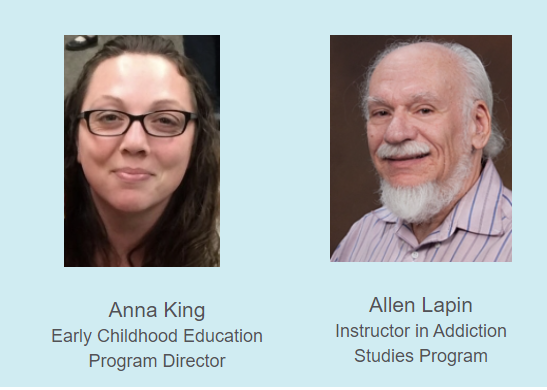
On April 6th, 2021 at 10am, The Clallam Resilience Project will convene via zoom for their monthly Community Meeting. This month will feature a presentation by Dr. Allen Lapin, a retired MD and current instructor in the Addiction Studies program, and Anna King, the director the Early Childhood Education Department. The two instructors will present on how they incorporate teaching about Adverse Childhood Experiences into their curriculum in order to prepare their students to support future clients.

Session details

Date: April 6, 2021
Time: 10 a.m. to 11:30 a.m. (PST)
Price: Free
Host/Facilitator: Anna King and Dr. Allen Lapin
Sponsors: Clallam Resilience Project and Clallam County United Way
CLE: Continuing education credit is not provided, but may be available from your respective licencing agency.
Zoom Meeting login: https://us02web.zoom.us/j/89928194489?pwd=Nmx4NkZ2eVpZbldNYk9tY2k4YUJNZz09
Meeting ID: 899 2819 4489
Passcode: HOPE

Presenters

Anna King is the Early Childhood Education Program Coordinator and Faculty for Peninsula College. Prior to working at the college Anna worked for OlyCAP in the Early Childhood Services programs. She is passionate about children having accesses to quality education programs.

Dr. Allen Lapin graduated from the University of Illinois College of Medicine in Chicago. He completed his residency at LA County -USC Medical Center, then served active-duty in the US Army Medical Corps for two years. He worked at the San Mateo County Medical Center for 29 years. He and his wife have now lived in Port Angeles for 21 years, and he serves as part-time faculty at Peninsula College, teaching about Addiction Studies in the Medical Assisting Department.

The Clallam Resilience Project Community Meetings take place the first Tuesday of every month and are open to the public. Meetings are posted at Meetings | Clallam Resilience Project (unitedwayclallam.org)

Questions about the event can be directed to: [email protected]

Filed Under: Bar News, CLE, Family Law, Mental health

Washington’s Minor Guardianship Court forms

December 8, 2020

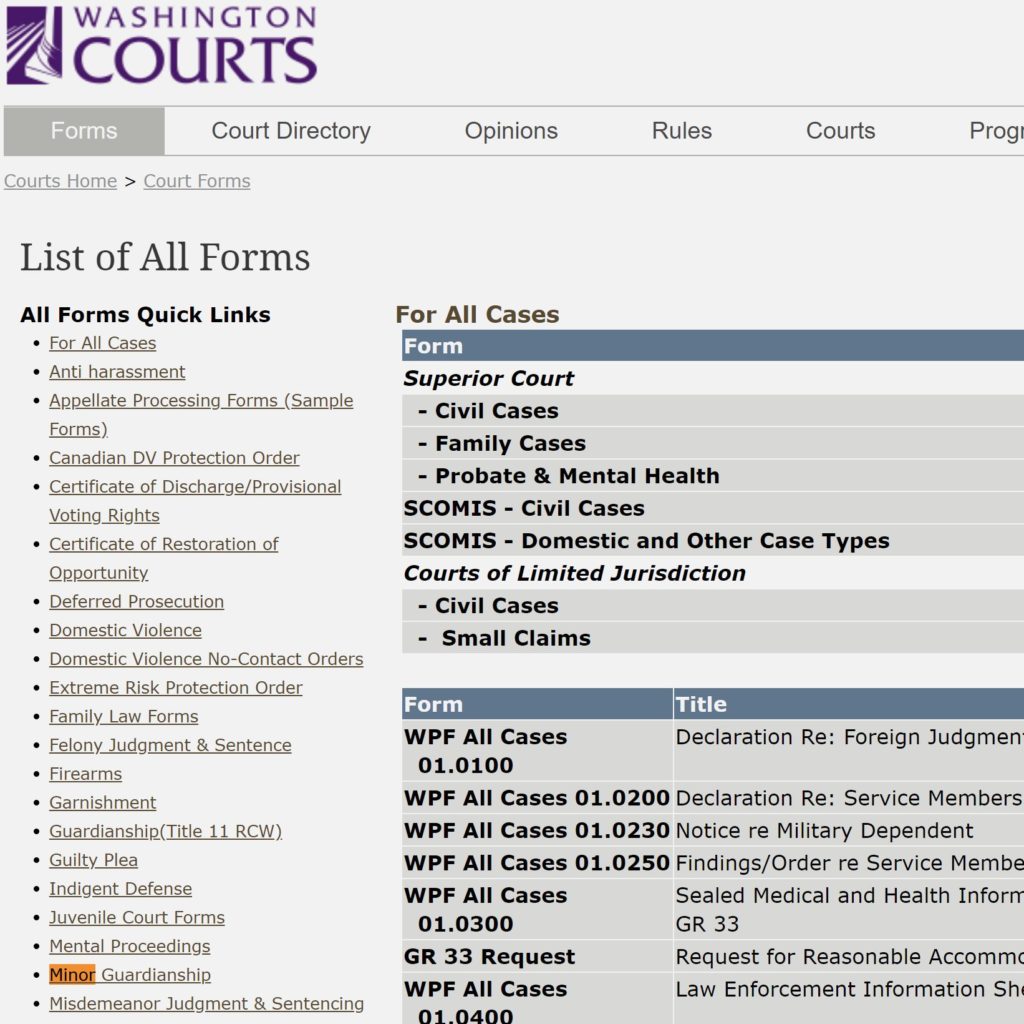
Washington State’s new Uniform Guardianship Act replaces the nonparent custody laws, and the official state forms are now available. The forms are currently available on the Washington Court’s List of All Forms page, just look for the Guardianship forms, then the minor guardianship forms, or clikc below. Click here for an article describing the minor guardianship law.

Click here for Washington Courts Minor Guardianship forms

If you go to the “List of All Forms page, look for the “Minor Guardianship” link on the page:

RCW 26.10, which governs third party custody, non-parent, and some grandparent rights laws, are being replaced by RCW 11.130, the new Uniform Guardianship Act. The new laws go into effect on January 21, 2021.

The new law is complicated. ClallamCountyBar.com recommends people interested in seeking the court’s help under this law should contact the Clallam County Facilitator, or consult with an attorney.

Filed Under: Bar News, Family Law

CLE: Overview of the new minor guardianship law

December 8, 2020

Credits: 1.5 Credits Pending
Date: DECEMBER 19, 2020
Time: 10:30am – Noon
Price: Free, suggested $35 donation to CJCPL
Zoom Link: https://us02web.zoom.us/webinar/register/WN_h3RS4PPeT4GfOmb2AnCYfQ

Clallam-Jefferson County Pro Bono Lawyers is sponsoring this CLE designed to provide an overview of the new minor guardianship statute that goes into effect on January 1, 2021. This law replaces the current non-parental custody statute and is quite different in many respects. Non-attorneys who are interested in being appointed as guardians ad litem or court visitors are also encouraged to attend. The presentation will also include valuable information on how the transitions from non-parental custodies to minor guardianships will be handled in Jefferson and Clallam County Clerk’s Offices and Superior Courts.

This CLE is free of cost, though participants will be encouraged to make a $35 donation to the Clallam-Jefferson County Pro Bono Lawyers.

Presenters include Commissioner Brandon Mack of Clallam County Superior Court, and Lorraine Rimson of Kurlin & Rimson Law Offices, PLLC, and Ruth Gordon, Jefferson County Clerk of Superior Court.

Filed Under: Bar News, CLE, Family Law

CLE: Secondary trauma and self care

September 23, 2020

Secondary Trauma & Self Care, a CLE by the Clallam Resilience Project.

Wed, Nov 4th, 9:00-11:00am
Free
This training will explain Secondary Traumatic Stress, Compassion
Fatigue and Vicarious Trauma. Participants will be able to
recognize warning signs and personal triggers, understand the
importance of self-care, and develop a personal self-care plan.

Click here to register:
https://centene.zoom.us/meeting/register/tJwofuCvrT4iGNGSAMz0yuxUuYlcF6ekeBKS

This is the last of the four resilience trainings by the Clallam Resilience Project for 2020.

The Clallam Resilience Project is a service of the United Way of Clallam County. The ACEs Study session is the first of four trainings in September, October, and November.

Filed Under: Bar News, CLE, Family Law, Parenting, Parenting Education

CLE: Fostering resiliency in children by Clallam Resilience Project

September 23, 2020

Resiliency
Wed, Oct 21, 9:00-11:00am
Free
This training provides information on how to foster resilience in
children. It looks at factors such as the human adaptive process,
core protective systems, and ways to cope with trauma. The
training ends with a discussion around how caregivers can help
their children feel safe, capable and loveable.

Click this link to register:
https://centene.zoom.us/meeting/register/tJwpduitqzwvHNStZ_PJtwF2H_8LlN8cuLZf

The Clallam Resilience Project is a service of the United Way of Clallam County. The ACEs Study session is the first of four trainings in September, October, and November.

Upcoming CLE’s by the Clallam Resilience Project

Secondary Trauma & Self Care
Wed, Nov 4th, 9:00-11:00am
Free
This training will explain Secondary Traumatic Stress, Compassion
Fatigue and Vicarious Trauma. Participants will be able to
recognize warning signs and personal triggers, understand the
importance of self-care, and develop a personal self-care plan.

Filed Under: Bar News, CLE, Family Law, High Conflict, Parenting, Parenting Education

CLE: Trauma 101 by Clallam Resilience Project

September 23, 2020

Wed, Oct 7, 9:00-11:00am
Free
This training defines trauma, and explores the impact of trauma on
an individual. It will heighten the professional’s awareness of client
cues so they will know what to expect and how to respond when
someone experiences trauma triggers.

Click this link to register:
https://centene.zoom.us/meeting/register/tJcucu6opzMsHtaumzZueLcc1huph_cVYCIy

The Clallam Resilience Project is a service of the United Way of Clallam County. The Trauma 101 session is the second of four trainings in September, October, and November.

Upcoming CLE’s by the Clallam Resilience Project

Resiliency
Wed, Oct 21, 9:00-11:00am
Free
This training provides information on how to foster resilience in
children. It looks at factors such as the human adaptive process,
core protective systems, and ways to cope with trauma. The
training ends with a discussion around how caregivers can help
their children feel safe, capable and loveable.

Secondary Trauma & Self Care
Wed, Nov 4th, 9:00-11:00am
Free
This training will explain Secondary Traumatic Stress, Compassion
Fatigue and Vicarious Trauma. Participants will be able to
recognize warning signs and personal triggers, understand the
importance of self-care, and develop a personal self-care plan.

Filed Under: Bar News, CLE, Family Law, High Conflict, Parenting, Parenting Education

CLE: Findings from the Adverse Childhood Experiences (ACEs) study

September 22, 2020

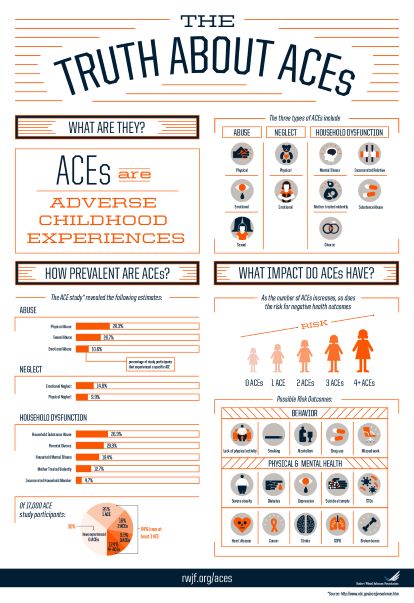
If you haven’t been introduced to the ACEs study, tomorrow is a free opportunity, and it will change your life. Now a world famous study, Adverse Childhood Experiences (ACEs) study found clear and significant negative and life-long impacts on both mental and physical health. The Clallam Resilience Project is offering this free two-hour training at 9:00 a.m. on Wednesday, September 23, 2020.

The ACES study findings are truly remarkable. Just Google ACEs study for more information.

Register here for the free ACEs Zoom session: https://centene.zoom.us/meeting/register/tJEvcu-upzkvGdYvQqwFrhK1syq9DH_F04Ul

The Clallam Resilience Project is a service of the United Way of Clallam County. The ACEs Study session is the first of four trainings in September, October, and November.

Workshop Description: This training explains the Adverse Childhood Experiences (ACEs) study and identifies all 10 ACEs. All childhood experiences have an impact on people as they mature. This training explores the long term effects that adverse childhood experiences have on physical and mental health. Preventative measures, resiliency, and how to address the needs of children with a high ACEs score are all discussed.

Time: Sep 23, 2020 09:00 AM in Pacific Time (US and Canada)

Additional workshops

Trauma 101, from 9-11 am on Wednesday, October 7, 2020

Resiliency, from 9-11 am on Wednesday, October 21, 2020

Secondary Trauma and Self Care, from 9-11 am on Wednesday, November 4, 2020

Filed Under: Bar News, CLE, Family Law, Parenting

SNACCMS: build “moral fiber” with enhanced extracurricular activities

September 20, 2020

SNACCMS stands for Sports, Nature, Arts, Culture, Clubs, Music, and Spirituality. These are activities for children which help them build neural networks with strong connections to the brain’s frontal lobes.

SNACCMS is an expanded version of “extracurricular activities”, and is intended to help parents thing more creatively about activities for their kids. Baseball, basketball, and soccer are all excellent activities, but so is any kind of art, music, organized clubs, spiritual or religious activities, birding, and tracking down wild blueberries in the Olympic mountains.

Staying out of trouble and avoiding drugs are well-known outcomes from SNACCMS type activities. Even better, there is a wide body of research confirming that kids who are involved with SNACCMS can learn to:

  1. Regulate their emotions,
  2. Enhance their cognitive thinking skills (critical thinking),
  3. Develop more attuned empathy and perspective taking,
  4. Improve their communication skills,
  5. Learn to make connections between things (such as nature and food sources),
  6. Become comfortable with taking on challenges, and
  7. Engage in self-directed learning.

(All of these skills are described by Ellen Galinsky in her book Mind in the Making: The seven essential skills every child needs.)

But there’s a trick to making SNACCMS work well for kids: the activities must be positive focused, promote skill building, allow children to learn to make decisions for themselves and experience the consequences in a safe and supportive environment, support positive interactions between peers, and involve adults modeling healthy behaviors.

Some of the relevant research studies include:

  • Protective factors for youth considered at risk of criminal behaviour: Does participation in extracurricular activities help?, Burton, J. M., & Marshal, L. A. (2005), Criminal Behaviour and Mental Health, 15, 46-64.
  • A systematic review of the impact of physical activity programmes on social and emotional well-being in at-risk youth, Lubans, D., Plotnikoff, R., Lubans N. (2012), Child and Adolescent Mental Health, 17:1, 2-13.
  • The Sports Challenge International Programme for identified ‘at risk’ children and adolescents: A Singapore study, Tester, G., Watins, G., Rouse, I, (1999), Asia Pacific Journal of Public Health, 11:1, 34-38.
  • Effects of participation in a martial arts–based antibullying program in elementary schools, Twemlow, S.W., Biggs, B.K., Nelson, T.D., Vernberg, E.M., Fonagy, P., Twemlow S.W. (2008), Psychology in the Schools, 45:10, 947-959.
  • Executive functions predict the success of top-soccer players, Vestberg, T., Gustafson, R., Maurex, L., Ingvar, M., Petrovic, P. (2012), PloS ONE, 7:4, 1-4.

SNACCMS was developed by Mark Baumann, J.D., to help his clients, particularly those involved in high conflict family law cases. Often, those cases involve one or more adults causing attachment-harm, and the courts are not well organized to help. Thus, it is up to the parents to cause attachment-healing, and SNACCMS are one of the most powerful ways to help. Clallam County SNACCMS opportunities are available at CCBA.com’s SNACCMS page. More information about SNACCMS from Mark Baumann is available here.

Filed Under: Family Law, Local feature articles, Parenting, Parenting Education, SNACCMS

  • « Go to Previous Page
  • Page 1
  • Page 2
  • Page 3
  • Page 4
  • Page 5
  • Page 6
  • Interim pages omitted …
  • Page 13
  • Go to Next Page »

Primary Sidebar

Courtroom Zoom information

Find a Lawyer

Local feature articles

USX-1 Defiant conducting sea trials in Port Angeles Harbor, passing by the Harbor Pilot ship dock.

USX-1 Defiant: sea trials in Port Angeles Harbor

August 28, 2025

8/28/2025 The brand new and experimental naval ship USX-1 Defiant is conducting sea trials in Port Angeles Harbor and the Strait of Juan de Fuca. The Defiant is a drone ship, … [Read More...] about USX-1 Defiant: sea trials in Port Angeles Harbor

Two varieties of Olympic Mountain blueberries, intertwined in what appears to be one bush

How many species of wild blueberries in Olympic National Park?

August 25, 2025

6, 8, 9, or 12 (?) kinds of wild blueberries in the Olympics? There are quite a few species of blueberries in the Olympic Mountains. A number of plant identification books … [Read More...] about How many species of wild blueberries in Olympic National Park?

More local feature articles

Legal Resources

  • Angeles Mediation
  • Avvo Legal Directory
  • Clallam Superior Court
  • Gov: City of Port Angeles
  • Gov: Clallam County
  • Gov: Superior Court Clerk
  • Law: Court forms
  • Law: RCW- WA statutes
  • Northwest Justice Project
  • Washington Law Help (free)
  • Washington State Bar Association

Categories

DV Blog

Courthouse Facilitator position vacant until March 1 2026

Hope Card: easy carry protection order information

Low Bono mediation 2023: Family Law Project

More DV information

Pro Bono

Free legal advice August 3 2026

July 14, 2026

The Clallam-Jefferson County Pro Bono Lawyers and the Elwha Klallam Heritage Center are offering … [Read More...] about Free legal advice August 3 2026

Courthouse Facilitator

December 1, 2019

The Courthouse Facilitator helps people find and fill out family law forms. They are not lawyers and … [Read More...] about Courthouse Facilitator

Free legal advice on Saturday July 18, 2026

May 17, 2026

On Saturday, July 18, 2026, the Clallam-Jefferson County Pro Bono Lawyers will provide a free legal … [Read More...] about Free legal advice on Saturday July 18, 2026

Free legal advice May 16 2026

May 7, 2026

Free one-on-one legal consultations with a lawyer are available on Saturday, May 16, 2026. These … [Read More...] about Free legal advice May 16 2026

Free legal advice for tenant rights, April 25 2026

April 16, 2026

A live presentation on tenant rights and evictions, and free one-on-one legal consultations with a … [Read More...] about Free legal advice for tenant rights, April 25 2026

Free legal advice Saturday February 21, 2026

January 14, 2026

On Saturday, February 21 , 2026, the Clallam-Jefferson County Pro Bono Lawyers will provide a free … [Read More...] about Free legal advice Saturday February 21, 2026

More pro bono news

Family Law News

Old red brick and white stone Clallam County Courthouse with bell tower

Family Court settlement conferences now 2.5 hours long

July 8, 2026

The Clallam County Family Court settlement conferences have increased from 1.5 hours to 2.5 hours. They are still offered on Mondays and Thursdays. On Monday, there are two settlement conference … [Read More...] about Family Court settlement conferences now 2.5 hours long

Brian Parker terminated from position of Clallam County Family Court Commissioner – effective immediately

February 11, 2026

Brian Parker, Clallam County Superior Court Family Court Commissioner, was abruptly terminated from his position on February 10, 2026. The Superior Court announced his appointment to the position in … [Read More...] about Brian Parker terminated from position of Clallam County Family Court Commissioner – effective immediately

Old Clallam County Courthouse

Courthouse Facilitator position vacant until March 1 2026

January 27, 2026

The Clallam County Courthouse Facilitator position is currently vacant. A new Facilitator will begin offering help with filling out court forms on March 1, 2026. Temporary help In the meantime, … [Read More...] about Courthouse Facilitator position vacant until March 1 2026

A view of the old and new Clallam County courthouses from 4th street, in Port Angeles

Maria Malkasian is the new Courthouse Facilitator

May 15, 2025

The Clallam County Court Facilitator is Maria Malkasian. Her office is now in room 3003 at the courthouse, across the hall from Courtroom 3, the Family Court, 223 East 4th Street, Port Angeles, WA … [Read More...] about Maria Malkasian is the new Courthouse Facilitator

More family law news

A sustainable site

CCB.com is a 1-tree sustainable website. https://www.websitecarbon.com/

Copyright © 2026 Mark Baumann